
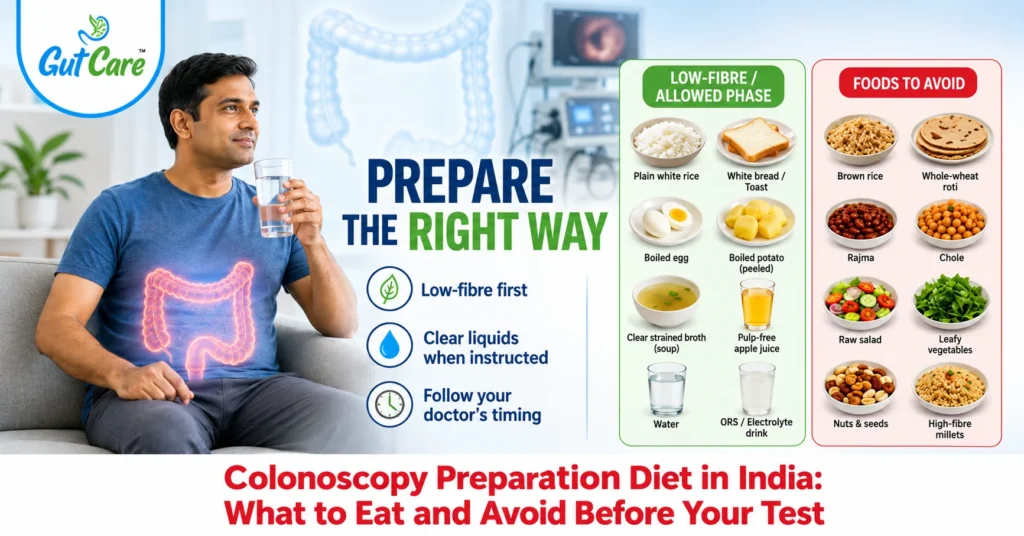
Preparing your bowel properly is one of the most important steps before a colonoscopy. A colonoscopy preparation diet in India usually involves temporarily reducing high-fibre foods and, depending on your doctor’s instructions, switching to low-fibre foods or clear liquids before the procedure.
Common Indian foods such as white rice, plain toast, eggs, and certain low-fibre preparations may be allowed during some stages of preparation. Foods such as brown rice, whole grains, raw vegetables, beans, nuts, seeds, and high-fibre millets may need to be avoided.
However, there is no single diet that is correct for every patient.
Your doctor’s written colonoscopy preparation instructions should always take priority because the required diet can vary according to your bowel-preparation medicine, medical history, procedure time, and risk of inadequate bowel cleansing.
If this is your first colonoscopy, you can also read GutCare Clinics’ colonoscopy procedure guide for first-time patients to understand what happens before, during, and after the test.
Why Is Diet Important Before a Colonoscopy?
A colonoscopy allows a doctor to examine the inside of your large intestine and rectum using a thin, flexible instrument fitted with a camera.
The colon needs to be sufficiently clean for the doctor to examine its lining properly.
Food residue and stool can make it difficult to see certain areas of the bowel. This is why colonoscopy preparation usually includes two important parts:
- Temporary dietary changes
- A prescribed bowel-cleansing medicine or laxative
Diet helps reduce the amount of residue entering the bowel, while the bowel-preparation medicine helps remove stool already present in the colon.
According to the National Institute of Diabetes and Digestive and Kidney Diseases, patients may be advised to avoid high-fibre foods such as whole grains, raw vegetables, beans, nuts, and seeds before colonoscopy. Some patients may also need to follow a clear-liquid diet before the procedure.
Colonoscopy Preparation Diet in India: Quick Food List
Here is a simple guide to foods that may be suitable during a low-fibre phase and foods that are commonly restricted.
| Foods That May Be Allowed During a Low-Fibre Phase | Foods Commonly Avoided |
| White rice | Brown rice |
| White bread or plain toast | Whole-wheat or multigrain bread |
| Eggs, if permitted | Rajma and chole |
| Plain chicken or fish, if permitted | Whole dals and pulses |
| Peeled, well-cooked potato | Raw vegetables |
| Refined pasta | Salads |
| Clear strained broth | Thick vegetable soup |
| Pulp-free clear juice | Juice with pulp |
| Water | Smoothies |
| Approved clear electrolyte drinks | Drinks with pulp or prohibited colours |
| Tea or coffee without milk during a permitted clear-liquid phase | Milk tea, lassi, or milk-based drinks during clear-liquid preparation |
Important: Once your doctor asks you to follow a clear-liquid-only diet, solid foods such as white rice, bread, idli, eggs, and potatoes should no longer be eaten.
What to Eat Before a Colonoscopy in India
If your medical team asks you to follow a low-fibre or low-residue diet, the goal is to temporarily reduce foods that leave significant undigested material in the intestine.
The exact duration varies.
Updated recommendations from the U.S. Multi-Society Task Force suggest that dietary restrictions for average-risk patients can generally be limited to the day before colonoscopy, using appropriate low-fibre, low-residue, or liquid options. Some people at higher risk of poor bowel preparation may require dietary changes for longer. You can read the current guidance from the American Society for Gastrointestinal Endoscopy.
Always follow the preparation schedule provided by your own doctor.
Indian Foods That May Fit a Low-Fibre Colonoscopy Diet
Indian diets vary considerably between regions and households, so a food should not be considered suitable simply because it appears on a generic online colonoscopy food list.
However, depending on your doctor’s instructions, some patients may be allowed foods such as:
- Plain white rice
- White bread or toast
- Refined pasta
- Peeled and well-cooked potato
- Eggs
- Plain fish
- Plain chicken
- Clear strained broth
- Certain refined-grain preparations
- Pulp-free clear juice
Preparation method matters.
For example, plain white rice may be very different from rice served with vegetables, whole lentils, seeds, or high-fibre accompaniments.
Similarly, a plain preparation may be acceptable during one stage of bowel preparation while its chutney, sambar, vegetables, or garnishes may not be.
Indian Foods to Avoid Before a Colonoscopy
If you have been instructed to follow a low-fibre diet, you may need to avoid foods such as:
- Brown rice
- Red rice
- Whole-wheat roti
- Whole-wheat chapati
- Multigrain bread
- Ragi
- Bajra
- Jowar
- High-fibre millets
- Rajma
- Chole
- Chana
- Whole moong
- Whole dals
- Beans
- Raw vegetables
- Salads
- Leafy vegetables
- Fruits with skin
- Fruits containing many seeds
- Dried fruits
- Nuts
- Seeds
- Corn
- Coconut pieces
- High-fibre breakfast cereals
These foods are not unhealthy. In fact, many of them are nutritious foods in a normal balanced diet.
They are restricted only temporarily because fibre and food residue can make bowel cleansing more difficult.
Can I Eat Rice Before a Colonoscopy?
Plain white rice may be allowed during a low-fibre colonoscopy preparation diet, depending on your doctor’s instructions. Brown rice and other high-fibre rice varieties are more likely to be restricted.
Once you are instructed to consume only clear liquids, stop eating rice because it is a solid food.
This distinction is important because a low-fibre diet and a clear-liquid diet are not the same thing.
Can I Eat Roti or Chapati Before a Colonoscopy?
Whole-wheat roti and chapati contain more fibre than refined-grain foods and may therefore be restricted during colonoscopy preparation.
If your doctor recommends a low-fibre diet, ask whether chapati is permitted and when you should stop eating it.
Do not assume that every patient needs to avoid chapati for three days. The required preparation period can differ between patients.
Can I Eat Idli Before a Colonoscopy?
Plain idli may sometimes be allowed during an earlier low-residue or low-fibre stage, depending on the preparation instructions provided by your doctor.
However, idli is still a solid food.
Once you begin a clear-liquid-only diet, idli should not be eaten.
Also consider what is served with it. Coconut chutney, seed-containing podi, vegetable-rich sambar, or other high-fibre accompaniments may not fit the prescribed preparation diet.
Can I Eat Dal Before a Colonoscopy?
Regular dal is not automatically suitable for colonoscopy preparation.
Lentils and pulses contain fibre, so whole dal, rajma, chana, and similar preparations may be restricted during a low-fibre phase.
If your doctor permits a strained liquid preparation, follow the clinic’s exact instructions.
Do not consider ordinary dal to be a clear liquid.
Can I Eat Curd or Buttermilk Before a Colonoscopy?
Curd and buttermilk are not clear liquids.
They may be permitted during an earlier dietary stage under some preparation plans, but they should not be consumed once your instructions specify clear liquids only unless your medical team specifically says otherwise.
The same rule applies to lassi and other dairy-based beverages.
What Should I Eat One Day Before a Colonoscopy?
The answer depends on your prescribed colonoscopy preparation protocol.
Some people may be allowed a low-fibre or low-residue breakfast and lunch before moving to clear liquids.
Others may receive instructions to use clear liquids for most or all of the day before colonoscopy.
Current professional guidance does not require every average-risk patient to follow exactly the same dietary approach.
This is why the safest rule is simple:
Follow the diet and timing written on your colonoscopy preparation sheet rather than using an online food list as a replacement.
What Is a Clear Liquid Diet for Colonoscopy?
A clear liquid diet for colonoscopy consists of liquids without pulp, solid material, or cream.
According to NIDDK, examples that may be allowed include water, fat-free broth, pulp-free fruit juice, and plain tea or coffee without milk or cream. Some doctors also advise avoiding red or purple liquids.
Depending on your specific preparation instructions, suitable options may include:
- Plain water
- Clear strained broth
- Pulp-free apple juice
- Other approved pulp-free clear juices
- Clear electrolyte drinks in permitted colours
- Black tea without milk
- Black coffee without milk or cream
Always check the permitted-drinks list given to you by the clinic.
What Should You Avoid During the Clear-Liquid Phase?
Once your doctor tells you to begin clear liquids only, avoid solid and non-clear foods or drinks such as:
- Rice
- Roti
- Idli
- Dosa
- Solid food of any kind
- Milk
- Milk tea
- Coffee with milk
- Lassi
- Buttermilk unless specifically permitted
- Smoothies
- Fruit juice with pulp
- Orange juice if prohibited by your instructions
- Thick soups
- Soups containing vegetables or grains
- Alcohol
Your medical team may also ask you to avoid red or purple drinks because the colour can interfere with visual assessment during colonoscopy. NIDDK specifically notes that doctors may recommend avoiding red and purple drinks or gelatin.
Sample Indian Colonoscopy Preparation Diet
The following is only an example of how a low-fibre phase may look.
It is not a substitute for your doctor’s colonoscopy preparation plan.
Breakfast
Depending on your instructions:
- White toast
- Egg
- Approved low-fibre breakfast
- Tea or coffee according to the permitted-food instructions
Mid-Morning
- Water
- Other approved drinks
Lunch
Depending on your preparation plan:
- Plain white rice
- Allowed low-fibre protein
- Approved low-fibre accompaniment
Evening
Once your clear-liquid phase begins:
- Water
- Clear strained broth
- Pulp-free approved juice
- Clear electrolyte beverage
- Black tea or coffee without milk, if allowed
Dinner
If your instructions say clear liquids only, do not eat a solid dinner.
Continue only with approved clear fluids until the fasting cut-off specified by your doctor.
Is a Low-Fibre Diet the Same as a Clear-Liquid Diet?
No.
This is one of the most important points to understand when following an Indian diet before colonoscopy.
A low-fibre diet can still contain solid foods such as white rice, white bread, or other permitted foods.
A clear-liquid diet does not contain solid food.
Therefore:
Low-fibre phase: Some selected solid foods may be permitted.
Clear-liquid phase: Solid foods stop.
Always confirm when you are supposed to move from one stage to the next.
Why Is Bowel-Prep Medicine Necessary?
Diet alone does not fully clean the colon.
Your doctor will prescribe a bowel-preparation medicine, often a laxative solution, to help empty the bowel.
The preparation causes frequent loose or watery bowel movements, so plan to remain close to a toilet once you begin taking it.
Modern recommendations generally favour a split-dose bowel-preparation regimen. The American Society for Gastrointestinal Endoscopy notes that, for split dosing, the second portion should generally begin about four to six hours before colonoscopy and be completed at least two hours before the procedure.
Your own doctor may give you a different schedule based on your appointment time and clinical circumstances.
Never change the dose or timing of your bowel-preparation medicine without medical advice.
How Much Water Should I Drink During Colonoscopy Preparation?
Maintaining hydration is important because bowel-preparation medicines cause repeated watery bowel movements.
Drink approved clear fluids while your preparation instructions permit them.
However, you will also receive a cut-off time for oral fluids before the procedure. Follow that time exactly, particularly if sedation or anaesthesia will be used.
Contact your endoscopy team if:
- You cannot keep liquids down
- You develop repeated vomiting
- You feel significantly weak or unwell
- You cannot complete the bowel preparation
- The preparation does not seem to be working
What If I Have Diabetes?
Colonoscopy preparation requires special planning for people with diabetes because reduced food intake and fasting can affect blood glucose levels.
If you use insulin or other diabetes medicines, discuss the preparation with your doctor beforehand.
Your medical team may give you individual instructions about:
- Medication timing
- Medication doses
- Blood glucose monitoring
- What liquids you can consume
- When to stop eating
- When to stop drinking
Do not adjust diabetes medicine on your own.
What About Blood Thinners and Other Medicines?
Tell your doctor about all medicines and supplements you take.
This is particularly important if you take:
- Anticoagulants
- Antiplatelet medicines
- Insulin
- Other diabetes medicines
- Iron supplements
- Medicines that affect bowel movements
- Other prescription medicines
Do not stop a blood thinner, diabetes medicine, or any other prescription treatment simply because you are preparing for colonoscopy.
Your doctor should decide whether any medicine needs to be continued, adjusted, or temporarily withheld.
If you have ongoing bowel symptoms and are unsure whether specialist assessment is appropriate, GutCare Clinics also provides guidance on when to see a gastroenterologist in Bangalore.
How Do I Know If Colonoscopy Preparation Is Working?
Once the bowel-preparation medicine starts working, you should expect frequent loose and watery bowel movements.
As the colon becomes cleaner, the bowel output generally becomes more watery and contains less solid material.
If you are still passing substantial solid stool near the time of your colonoscopy despite following the instructions, contact your endoscopy team.
Do not take additional bowel-preparation medicine unless instructed to do so.
Common Colonoscopy Preparation Mistakes
1. Eating High-Fibre Foods Because They Are Healthy
Whole grains, fruits, vegetables, pulses, nuts, and seeds are normally valuable parts of a healthy diet.
However, they may need to be temporarily restricted before colonoscopy.
2. Confusing Liquids With Clear Liquids
Not every drink qualifies as a clear liquid.
Milk tea, lassi, smoothies, thick soup, and fruit juice with pulp are examples of liquids that do not meet the usual definition of a clear liquid.
3. Eating the Right Food With the Wrong Accompaniment
Plain rice might fit an earlier low-fibre diet, but adding whole dal, vegetables, seeds, or other fibre-rich accompaniments may change the meal considerably.
4. Eating Solid Food After Starting Clear Liquids
Once your preparation instructions say clear liquids only, stop all solid food.
5. Taking the Bowel Preparation Too Early or Too Late
Timing influences bowel-cleansing quality.
Take each dose exactly as instructed.
6. Not Drinking Enough Permitted Fluid
Frequent bowel movements can increase fluid loss.
Use the permitted clear fluids according to your preparation instructions.
7. Stopping Prescription Medicines Yourself
Some medicines may need adjustment, but the decision should be made with your healthcare team.
8. Following a Generic Internet Diet Instead of Your Doctor’s Instructions
A blog can explain what colonoscopy preparation involves, but it cannot account for every patient’s medical conditions, medications, bowel-preparation product, or procedure time.
Your clinic’s written instructions come first.
Why Proper Colonoscopy Preparation Matters
Colonoscopy is used to examine the colon and rectum for abnormalities such as inflammation, polyps, bleeding sources, and other colorectal problems.
Good bowel preparation gives the clinician a clearer view of the intestinal lining.
For readers who want to understand why colonoscopy may be recommended, GutCare Clinics’ colonoscopy procedure guide explains the examination in more detail.
Colonoscopy may also form part of the investigation or screening pathway for colorectal disease. You can learn more about colon cancer screening in Bangalore and colorectal cancer treatment on the GutCare Clinics website. GutCare’s existing pages describe colonoscopy as part of its digestive diagnostic services.
When Should You Speak to a Gastrointestinal Specialist?
A colonoscopy is not something you should arrange solely based on an online symptom list.
A doctor may recommend further evaluation when symptoms, medical history, age, family history, examination findings, or previous investigations suggest that colon assessment is appropriate.
Symptoms that may require medical evaluation include:
- Persistent changes in bowel habits
- Rectal bleeding
- Unexplained blood in stool
- Persistent abdominal discomfort
- Ongoing constipation
- Unexplained weight loss
- Other persistent digestive symptoms
People experiencing chronic constipation can also read about constipation treatment at GutCare Clinics.
For broader digestive evaluation, see GutCare’s gastroenterology treatment in Bangalore.
FAQs
What can I eat 2 days before a colonoscopy in India?
If your doctor asks you to use a low-fibre diet, you may be allowed foods such as white rice, white bread, eggs, or other low-fibre foods listed in your preparation instructions. Whole grains, raw vegetables, beans, nuts, and seeds are commonly restricted. Not every patient needs dietary restriction for exactly two days.
What can I eat one day before a colonoscopy?
This depends on your prescribed bowel-preparation plan. Some patients may be allowed low-fibre or low-residue foods during part of the day, while others may need clear liquids. Follow the schedule provided by your doctor rather than assuming that every colonoscopy uses the same diet.
What foods should I avoid before a colonoscopy?
Commonly restricted high-fibre foods include whole grains, raw vegetables, beans, nuts, and seeds. Once you begin clear liquids only, all solid foods are avoided.
What happens if I accidentally eat before my colonoscopy?
Do not automatically cancel the procedure and do not take extra laxatives yourself. Contact the clinic or endoscopy team and tell them what you ate, how much you ate, and when you ate it. They can advise whether the procedure can continue as scheduled.
When should I stop drinking water before a colonoscopy?
Your doctor or endoscopy unit will give you a specific fasting cut-off. Current split-dose bowel-preparation guidance commonly requires completion of the second bowel-prep portion at least two hours before colonoscopy, but your own fasting instructions should take priority.
Can I eat normally after a colonoscopy?
Your medical team will tell you when to restart food after the test, particularly if sedation was used or a biopsy or treatment was performed. Follow your discharge instructions rather than assuming that everyone can immediately return to a normal diet.
Colonoscopy Preparation Diet Checklist
Before your colonoscopy:
- Read the complete preparation instructions supplied by your doctor.
- Confirm when dietary restrictions begin.
- Confirm whether you need a low-fibre diet, clear-liquid diet, or both.
- Buy your permitted foods and drinks beforehand.
- Avoid high-fibre foods during the period specified by your doctor.
- Stop solid food when instructed.
- Take the prescribed bowel-preparation medicine exactly as directed.
- Drink approved fluids while permitted.
- Discuss diabetes medicines, blood thinners, and other relevant treatments beforehand.
- Confirm the final cut-off time for liquids.
- Contact your medical team if you cannot complete the bowel preparation.
- Do not modify your preparation based solely on advice found online.
Conclusion
A good colonoscopy preparation diet in India does not require guessing which Indian foods are safe. The key is understanding which stage of preparation you are in.
During a prescribed low-fibre phase, foods such as plain white rice or other low-fibre choices may be permitted. High-fibre foods such as brown rice, whole grains, rajma, chole, raw vegetables, nuts, and seeds are commonly restricted.
Once you begin a clear-liquid-only phase, all solid food stops.
Most importantly, the preparation instructions provided by your doctor should always take priority over a generic colonoscopy preparation food list.
If you have been advised to undergo colonoscopy or need evaluation for persistent bowel or digestive symptoms in Bengaluru, you can learn more about GutCare Clinics in Bangalore or review GutCare’s gastroenterology services in Bangalore.
Medical Disclaimer: This article provides general educational information and is not a substitute for personalised medical advice. Colonoscopy preparation can vary according to your health, medications, procedure time, and prescribed bowel-preparation product. Always follow the instructions provided by your treating doctor or endoscopy centre.