
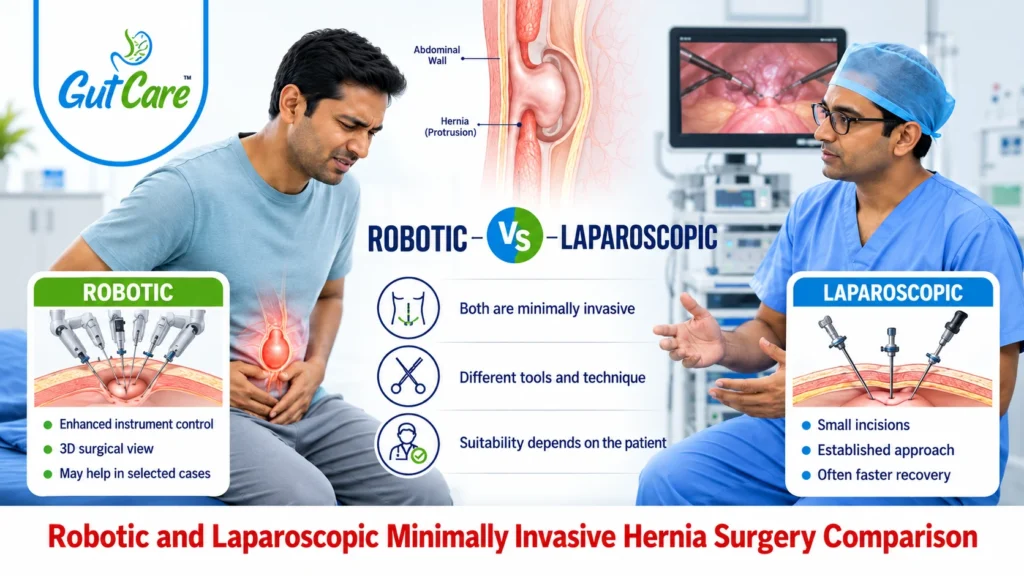
Robotic and laparoscopic hernia surgery are both minimally invasive approaches that can repair a hernia through small incisions. The main difference lies in how the surgeon controls the instruments.
In laparoscopic hernia surgery, the surgeon directly operates long instruments while viewing the surgical area on a monitor.
In robotic hernia surgery, the surgeon sits at a console and controls robotic instruments that move inside the patient’s body. The robot does not operate independently.
For many straightforward hernias, both techniques can provide good results. Current research has not established robotic surgery as universally superior to conventional laparoscopy. Robotic systems can provide enhanced instrument movement, three-dimensional visualisation, and ergonomic advantages for the surgeon, while laparoscopic surgery has a long track record, wide availability, and can be more efficient and less costly in many settings.
The right approach depends on the type of hernia, its size and location, whether it is recurrent or complex, previous abdominal surgery, the repair technique required, and the surgeon’s experience.
Patients considering minimally invasive treatment can also read GutCare Clinics’ guide to laparoscopic hernia surgery in Bangalore. GutCare currently lists laparoscopic, open, and robotic-assisted approaches among the options that may be considered for hernia repair.
Robotic vs. Laparoscopic Hernia Surgery: At a Glance
| Feature | Laparoscopic Hernia Surgery | Robotic Hernia Surgery |
| Incisions | Small | Small |
| Camera view | High-definition video, commonly 2D or 3D depending on system | Magnified 3D view on robotic platform |
| Instrument control | Surgeon directly controls laparoscopic instruments | Surgeon controls robotic instruments from a console |
| Instrument movement | More limited range than wristed robotic instruments | Wristed instruments provide greater articulation |
| Surgeon operates procedure | Yes | Yes |
| Robot operates independently | No | No |
| General anaesthesia | Commonly required | Commonly required |
| Mesh commonly used | Yes, depending on repair | Yes, depending on repair |
| Recovery | Usually minimally invasive recovery | Usually minimally invasive recovery |
| Cost | Often lower | Often higher |
| Availability | Widely available | Requires robotic platform and trained team |
| Best choice | Depends on hernia and surgeon | Depends on hernia and surgeon |
Neither column automatically represents the “better” treatment.
Laparoscopic Hernia Surgery
Laparoscopic hernia repair is an established minimally invasive technique.
The surgeon makes several small incisions and inserts a camera and narrow surgical instruments. The abdominal wall is viewed on a monitor while the hernia is repaired from inside or behind the weakened area.
For groin hernias, two widely used minimally invasive techniques are:
- TAPP, or transabdominal preperitoneal repair
- TEP, or totally extraperitoneal repair
Both approaches allow mesh to be positioned in the preperitoneal space to reinforce the weakened groin.
International HerniaSurge guidance supports laparo-endoscopic repair as an established treatment option for groin hernia when suitable expertise and resources are available. The choice of technique should take individual patient and hernia characteristics into account.
GutCare Clinics provides additional information about laparoscopic hernia treatment in Bangalore.
Robotic Hernia Surgery
Robotic hernia repair is also a minimally invasive operation, but the instruments are connected to a robotic surgical platform.
The surgeon controls the instruments from a console rather than holding them directly at the operating table.
This distinction is important.
A robot does not decide where to cut, where to place mesh, or how to repair the hernia. The surgeon remains in control throughout the procedure.
Robotic platforms can provide:
- Magnified three-dimensional visualisation
- Wristed instruments with a greater range of motion
- Fine instrument control
- Improved operating ergonomics for the surgeon
- Easier suturing in some technically demanding situations
These features can be useful when the surgeon needs to work in confined spaces, perform extensive suturing, reconstruct abdominal wall layers, or place mesh in more complex tissue planes.
Recent research also suggests robotic systems may improve surgeon ergonomics, although better surgeon ergonomics does not automatically mean better patient outcomes in every case.
The Biggest Difference Is the Surgical Platform
Patients sometimes imagine robotic surgery as a completely different operation from laparoscopic surgery.
In reality, many of the underlying surgical principles can be similar.
For example, a robotic inguinal hernia repair often uses a robotic version of the TAPP approach. The surgeon still enters the relevant anatomical plane, reduces the hernia, covers the defect, and usually places mesh.
The difference is largely in how the surgeon visualises and manipulates the tissues.
This is one reason comparisons based only on the words “robotic” and “laparoscopic” can be misleading.
The exact repair technique matters just as much as the platform used to perform it.
Recovery After Robotic and Laparoscopic Hernia Surgery
Both approaches are designed to minimise large abdominal incisions.
As a result, patients undergoing appropriate minimally invasive hernia repair may experience:
- Smaller incisions
- Early mobilisation
- Shorter hospital stay than some open repairs
- Earlier return to routine activity
- Less wound-related disruption
However, recovery should not be marketed as automatically faster after robotic surgery.
For many routine hernias, available evidence suggests that postoperative outcomes between robotic and laparoscopic repair can be similar. A 2025 systematic review of groin hernia surgery found robotic repair to be safe and effective but identified operative time and cost as continuing concerns.
The patient’s actual recovery depends on:
- Hernia size
- Hernia location
- Type of repair
- Whether the hernia is recurrent
- Amount of tissue dissection
- Mesh placement
- General health
- Age
- Physical activity
- Complications, if any
A small primary inguinal hernia and a large recurrent incisional hernia should not be expected to have the same recovery simply because both were repaired robotically.
Pain After Minimally Invasive Hernia Surgery
Pain is one of the most important outcomes for patients comparing techniques.
Both robotic and laparoscopic approaches aim to reduce surgical trauma compared with larger open incisions in suitable cases.
Some recent studies have reported differences in early pain or patient-reported outcomes, but the overall body of evidence has not established a consistent, clinically important pain advantage for robotic repair across all hernia types.
A 2025 Indian study reported encouraging short-term pain and quality-of-life outcomes with robotic-assisted inguinal hernia repair, but the study itself does not establish that robotic repair is universally superior to laparoscopy.
This is an important distinction for patients.
A technologically advanced platform may offer technical advantages to the surgeon without necessarily producing a dramatic difference in pain for every patient.
Operative Time
Operating time is one area where laparoscopic repair has historically had an advantage in several comparisons.
A 2024 meta-analysis of inguinal hernia repair found laparoscopic procedures were shorter on average than robotic-assisted procedures in the studies analysed.
More recent data are less uniform.
For example, the 2025 DIRECT randomised trial reported shorter operative time with robotic-assisted inguinal hernia repair in its study setting.
This apparent conflict is useful for patients to understand.
Operating time depends on:
- Surgical technique
- Surgeon experience
- Learning curve
- Robotic docking workflow
- Whether the repair is unilateral or bilateral
- Complexity of the hernia
- Hospital team experience
For this reason, a single number for “robotic surgery time” or “laparoscopic surgery time” is not particularly meaningful outside a specific clinical context.
Robotic Surgery and Complex Hernias
The potential value of robotics may become more relevant as the operation becomes technically complex.
Examples can include:
- Large ventral hernias
- Incisional hernias
- Recurrent hernias
- Hernias requiring extensive abdominal wall reconstruction
- Situations requiring significant intracorporeal suturing
- Repairs requiring mesh placement in deeper tissue planes
The articulated robotic instruments can make suturing and dissection easier for some surgeons.
Robotic platforms have also supported the wider minimally invasive adoption of techniques that traditionally required more technically demanding laparoscopic suturing.
However, this does not mean every complex hernia should be treated robotically.
Complex abdominal wall reconstruction should be planned according to anatomy, previous operations, mesh position, patient risk factors, and the experience of the treating surgical team.
Straightforward Hernias May Not Need Robotic Technology
For a routine unilateral inguinal hernia, conventional laparoscopy may provide an excellent minimally invasive repair.
This is one area where marketing can distort the decision.
A patient should not assume:
newer technology = better operation
Robotic technology can add capabilities, but whether those capabilities provide a meaningful advantage depends on whether the operation actually requires them.
A highly experienced laparoscopic hernia surgeon may achieve an excellent result using conventional laparoscopy for a straightforward hernia.
Conversely, a surgeon experienced in robotic abdominal wall surgery may find robotics particularly useful for a technically demanding repair.
The platform should fit the operation, not the other way around.
Cost and Availability
Cost is a practical difference between the two approaches.
Robotic surgery requires:
- A robotic surgical platform
- Dedicated instruments
- Maintenance and operating infrastructure
- Trained theatre staff
- Surgeon-specific robotic training
This can increase procedural and hospital costs.
Recent evidence continues to identify cost as one of the main disadvantages of robotic hernia repair. A 2026 systematic review of robotic versus laparoscopic TAPP inguinal hernia repair concluded that robotic TAPP was safe and effective but that clear clinical superiority over laparoscopy had not been demonstrated and cost-effectiveness remained uncertain.
Insurance coverage, hospital pricing, room category, mesh type, complexity, and length of stay can also influence the final cost in India.
Patients comparing hernia surgery options should ask for an estimate based on their actual operation rather than relying on a generic online price.
Hernia Type Matters More Than the Word “Robotic”
“Hernia” covers several different conditions.
- Inguinal Hernia
An inguinal hernia develops in the groin.
Laparoscopic TAPP and TEP are established minimally invasive techniques. Robotic TAPP is another option in centres with the necessary expertise.
- Bilateral Inguinal Hernia
When hernias are present on both sides of the groin, a minimally invasive posterior repair can allow both sides to be treated through the same set of small incisions.
Whether this is performed laparoscopically or robotically depends on patient and surgeon factors.
- Recurrent Inguinal Hernia
Previous surgery changes the anatomy and may influence which plane the surgeon chooses for the next repair.
Treatment planning should consider the technique used during the first operation.
- Umbilical Hernia
Small umbilical hernias may be treated differently from larger defects.
Not every umbilical hernia requires a complex robotic reconstruction.
- Ventral and Incisional Hernia
These hernias can range from relatively small defects to major abdominal wall problems following previous surgery.
The larger and more complex the defect, the more important the reconstruction strategy becomes.
A 2025 review comparing robotic, laparoscopic, and open ventral hernia repair found similar efficacy between laparoscopic and robotic approaches for outcomes including recurrence, seroma, and haematoma in the data evaluated.
GutCare Clinics discusses different treatment approaches on its hernia treatment page.
Mesh Use in Both Approaches
Both laparoscopic and robotic hernia repairs commonly use surgical mesh.
Mesh reinforces the weakened abdominal wall and can reduce recurrence in appropriate hernia repairs.
Robotic surgery does not automatically involve a special “robotic mesh.”
The surgeon chooses the mesh based on factors such as:
- Type of hernia
- Size of defect
- Surgical plane
- Patient characteristics
- Repair technique
- Risk of contamination
Patients concerned about mesh can read GutCare Clinics’ related guide on hernia mesh safety.
The important questions are not simply whether mesh is used, but which mesh is used, where it is placed, why that position is appropriate, and how the surrounding tissue is reconstructed.
Surgeon Experience Is a Major Part of the Decision
Technology cannot replace surgical judgement.
A robotic system may provide excellent visualisation and instrument control, but outcomes still depend heavily on the surgeon’s understanding of abdominal wall anatomy and ability to select and execute the right repair.
The European Hernia Society has specifically developed training recommendations for robotic abdominal wall surgery, reflecting the fact that robotic hernia repair has its own learning curve and requires structured training.
When considering surgery, patients should focus on questions such as:
- How often does the surgeon perform this type of hernia repair?
- Does the surgeon perform both laparoscopic and robotic techniques?
- Why is one technique being recommended for this hernia?
- Is the recommendation based on anatomy or simply platform availability?
- Where will the mesh be placed?
- What is the expected recovery?
- What complications are most relevant in this particular case?
A surgeon who can explain why a technique fits the patient’s anatomy is more useful than a simple claim that one technology is “advanced.”
Robotic Surgery Is Still Surgeon-Controlled Surgery
One misconception deserves its own explanation.
The robot does not perform the operation by itself.
The surgeon sits at the robotic console and controls the camera and surgical instruments. The robotic system translates the surgeon’s hand movements into precise instrument movements inside the patient.
Current clinical robotic surgery is therefore better described as robot-assisted surgery.
There is a human surgeon making the decisions throughout the procedure.
Safety of Both Approaches
Both laparoscopic and robotic hernia repairs are established minimally invasive surgical approaches when performed in appropriately selected patients by trained teams.
Potential complications can include:
- Bleeding
- Infection
- Seroma
- Injury to nearby structures
- Urinary retention
- Pain
- Mesh-related complications
- Hernia recurrence
- Anaesthesia-related complications
The risk profile depends on the hernia and repair rather than the surgical platform alone.
Recent research continues to show broadly similar overall outcomes between robotic and laparoscopic repair in many patient groups, although individual studies can report differences in particular outcomes.
The Practical Decision Framework
For most patients, the decision becomes clearer when it is broken into five factors.
1. Hernia Anatomy
The surgeon should define:
- Type
- Location
- Size
- Number of defects
- Whether the hernia is recurrent
- Whether previous mesh is present
2. Complexity of Reconstruction
Simple repairs may not require the added capabilities of a robotic system.
More complex suturing or abdominal wall reconstruction may make those capabilities more useful.
3. Surgeon Expertise
The surgeon’s experience with the exact repair is more important than choosing technology based on marketing.
4. Expected Patient Benefit
There should be a clear reason why robotic surgery is expected to benefit the individual patient.
If clinical outcomes are expected to be similar, cost and availability become more important considerations.
5. Cost and Insurance
Patients should confirm:
- Hospital charges
- Robotic surgery charges
- Mesh costs
- Insurance coverage
- Expected hospital stay
- Additional disposable-device costs
This is especially relevant when comparing robotic and laparoscopic hernia surgery in India.
A Balanced Choice Instead of a Technology Contest
The useful comparison is not:
Robot versus human surgeon.
It is also not:
new technology versus old technology.
Both robotic and laparoscopic surgery are performed by surgeons, and both can be advanced minimally invasive techniques.
The real decision is:
Which technique gives this patient a safe, durable repair while matching the anatomy, complexity, surgeon expertise, recovery goals, and cost considerations?
For many uncomplicated hernias, laparoscopic repair remains an excellent option.
For selected complex abdominal wall repairs, the robotic platform may offer technical advantages that help the surgeon perform minimally invasive reconstruction.
In other cases, open surgery may still be the most appropriate operation.
GutCare Clinics currently describes open, laparoscopic, and robotic-assisted approaches as available hernia treatment options depending on individual needs.
FAQs
Is robotic hernia surgery better than laparoscopic surgery?
Not for every patient. Both are minimally invasive approaches, and current evidence does not establish robotic hernia repair as universally superior. Robotic surgery may provide technical advantages for certain complex repairs, while conventional laparoscopy remains highly effective for many routine hernias.
Is robotic hernia surgery safer than laparoscopic surgery?
Available evidence generally suggests that both can be safe when performed in appropriately selected patients by experienced surgeons. The individual risk depends on the hernia, operation, patient health, mesh placement, and surgeon expertise rather than the platform alone.
Is recovery faster after robotic hernia surgery?
Not necessarily. Both robotic and laparoscopic repairs use small incisions and generally have minimally invasive recovery pathways. Research has not consistently demonstrated a major recovery advantage for robotic repair across all hernia types.
Is robotic hernia surgery more painful than laparoscopic surgery?
Pain outcomes vary. Some studies report differences in early postoperative pain, while others show similar outcomes. Hernia type, extent of dissection, mesh fixation, nerve irritation, and individual pain response can all affect recovery.
Does robotic hernia surgery use mesh?
Many robotic hernia repairs use mesh, just as many laparoscopic repairs do. The appropriate mesh and placement depend on the type of hernia and surgical technique.
Is the robot performing the surgery itself?
No. The surgeon controls the robotic instruments throughout the operation. The robotic platform assists with visualisation and movement but does not independently decide or perform the repair.
Which approach is better for an inguinal hernia?
Both laparoscopic and robotic approaches can be used for inguinal hernia repair. Laparoscopic TAPP and TEP have extensive clinical experience behind them. Robotic TAPP is an additional minimally invasive option. The best choice depends on the hernia, surgeon expertise, previous operations, cost, and patient preferences.
Is robotic surgery useful for a recurrent hernia?
It may be useful in selected recurrent or complex cases, but recurrence alone does not automatically make robotic surgery necessary. The previous repair technique and location of existing mesh are particularly important when planning another operation.
Which approach is better for an incisional hernia?
Incisional hernias vary widely in size and complexity. Both laparoscopic and robotic techniques may be appropriate in selected cases, while complex abdominal wall reconstruction may require a more individualised strategy. Current comparative evidence does not support one platform as universally best.
Is robotic hernia surgery more expensive?
It often is because robotic procedures require specialised equipment, instruments, and infrastructure. The actual difference varies between hospitals and insurance policies. Published research continues to identify cost as an important limitation of robotic hernia surgery.
Can a hernia return after robotic or laparoscopic surgery?
Yes. Recurrence is possible after any type of hernia repair. Hernia size, mesh placement, surgical technique, tissue quality, smoking, obesity, wound problems, and other patient factors can influence recurrence.
How should I choose between robotic and laparoscopic hernia surgery?
Choose after discussing your exact hernia anatomy, repair technique, expected benefit, surgeon experience, risks, recovery, and cost. The best operation is the one that appropriately matches your condition, rather than automatically choosing whichever technology sounds newer.
Conclusion
The robotic vs laparoscopic hernia surgery decision should not be treated as a contest in which one technology wins for every patient.
Both are minimally invasive approaches, and both can provide effective hernia repair when used appropriately.
Laparoscopic surgery has a long track record, established techniques such as TAPP and TEP, wide availability, and often lower cost.
Robotic hernia surgery provides three-dimensional visualisation, articulated instruments, and technical advantages that can make suturing and complex reconstruction easier for some surgeons. These features may be particularly valuable in selected complex abdominal wall repairs.
However, the latest evidence does not establish robotic surgery as universally superior to laparoscopic repair. Some studies show similar clinical outcomes, while cost and operating time remain important considerations.
The most important factors are your hernia type, anatomy, previous surgery, the repair that needs to be performed, and the surgeon’s expertise with that technique.
Patients considering hernia surgery in Bengaluru can review GutCare Clinics’ laparoscopic hernia surgery in Bangalore and hernia treatment options before discussing which approach fits their individual condition.
Medical Disclaimer: This article provides general educational information and does not replace individual assessment or surgical advice. The appropriate hernia repair technique depends on your diagnosis, anatomy, health, previous operations, and the judgement of your treating surgeon.