
Hernia mesh is widely used to strengthen weakened tissue during hernia repair and can reduce the chance of the hernia returning compared with many non-mesh techniques. For most adults undergoing groin hernia repair, international guidelines support a mesh-based repair when it is appropriate for the individual patient.
However, hernia mesh is not completely risk-free.
Possible complications include pain, infection, fluid collection, recurrence, adhesions, bowel obstruction, and, less commonly, problems involving the mesh itself. The safest approach is not simply choosing “mesh” or “no mesh.” It is choosing the right repair technique, mesh type, placement, and surgeon for the patient’s specific hernia.
The U.S. Food and Drug Administration states that most hernia repair procedures use surgical mesh and continues to monitor the safety of these devices. HerniaSurge guidance also reports that mesh repair generally reduces recurrence compared with non-mesh groin hernia repair. Read the FDA guidance on surgical mesh for hernia repair.
Patients considering surgery in Bengaluru can also read GutCare Clinics’ guide to laparoscopic hernia surgery in Bangalore.
Understanding Hernia Mesh
Hernia mesh is a medical implant used to reinforce an area of weakened muscle or connective tissue.
During a hernia repair, the surgeon returns protruding tissue to its correct position and closes or reinforces the defect in the abdominal wall. Mesh can be positioned over or around the weak area to distribute tension and support healing.
The purpose is to create a stronger repair without relying entirely on sutures to pull weakened tissue together.
Different meshes vary in material, structure, weight, pore size, coating, and whether they remain permanently in the body or are gradually absorbed.
The choice of mesh depends on several factors, including:
- Type of hernia
- Size of the defect
- Location of the hernia
- Previous surgery
- Open or minimally invasive approach
- Patient health
- Risk of infection
- Surgeon experience
- Characteristics of the mesh
There is no single mesh that is ideal for every patient.
Mesh Repair Has Become a Standard Option
Mesh-based repair is widely used for inguinal, incisional, umbilical, and other abdominal wall hernias.
The main advantage is reinforcement.
Traditional tissue-only repairs close the defect using the patient’s tissues and sutures. This can place tension on the surrounding tissue, especially when the defect is larger or the tissue is weak.
Mesh repair allows reinforcement across a wider area.
The updated international HerniaSurge guideline notes that mesh repair lowers recurrence compared with non-mesh repair for groin hernias. This evidence is one of the reasons mesh has become an established part of modern hernia surgery.
GutCare Clinics lists tension-free mesh repair among the treatment options available for hernia management. You can read more about the clinic’s hernia treatment options in Bangalore.
Main Benefits of Hernia Mesh
Lower Risk of Hernia Recurrence
One of the main goals of mesh is to reduce the likelihood that the hernia will return.
A review comparing mesh and non-mesh groin hernia repair found that mesh repair was associated with lower recurrence, with no overall difference in safety outcomes in the evidence evaluated.
Recurrence risk is still influenced by factors such as hernia type, smoking, obesity, surgical technique, tissue quality, and postoperative strain.
Mesh does not guarantee that a hernia can never return.
Tension-Free Reinforcement
Mesh can reinforce the weak area without requiring the surgeon to pull tissue together under excessive tension.
Reducing tension is one of the principles behind many modern hernia repair techniques.
Support for Larger Hernia Defects
Mesh can be particularly useful when the abdominal wall defect is large, recurrent, or associated with weakened tissue.
The repair can extend beyond the edges of the defect, providing reinforcement across a wider area.
Suitability for Open and Minimally Invasive Repair
Mesh may be used during both open and laparoscopic hernia repair.
With laparoscopic surgery, the surgeon generally operates through several small incisions using a camera and specialised instruments. GutCare Clinics currently provides both open and laparoscopic approaches based on individual patient needs.
Read more about laparoscopic hernia treatment in Bangalore.
Hernia Mesh Safety Depends on More Than the Implant
Searches for “hernia mesh safety” often focus entirely on the mesh product.
In reality, outcome depends on several interacting factors.
These include:
Patient selection: Age, diabetes, obesity, smoking, previous abdominal operations, immune status, and other medical conditions may influence healing and complication risk.
Type of hernia: An inguinal hernia does not necessarily require the same approach as a large incisional or recurrent hernia.
Mesh selection: Different locations and surgical techniques can require different mesh characteristics.
Mesh position: Where the mesh is placed relative to muscles, fascia, and abdominal organs matters.
Fixation technique: Mesh may be secured using sutures, tacks, adhesive, or other methods depending on the procedure.
Surgical technique: Tissue handling, dissection, nerve preservation, sterile technique, and appropriate mesh overlap can affect outcomes.
Surgeon experience: Hernia repair is not simply a matter of inserting mesh. Choosing and performing the appropriate repair is a significant part of achieving a good result.
Possible Risks of Hernia Mesh Surgery
The FDA lists several adverse events that may occur after hernia surgery, with or without mesh. These include pain, infection, recurrence, adhesions, obstruction, bleeding, fistula, seroma, and perforation.
It is important to discuss these risks without assuming that every complication following hernia surgery is caused by the mesh.
- Postoperative Pain
Some discomfort is expected during recovery after hernia surgery.
Persistent or chronic pain is a recognised concern after groin hernia repair. Causes can include nerve irritation, scar tissue, fixation methods, recurrent hernia, inflammation, or other factors.
HerniaSurge guidelines specifically identify reduction of chronic pain as an important goal in improving groin hernia surgery outcomes.
- Mesh Infection
Mesh infection is an important but not inevitable complication.
Risk can depend on the type of surgery, wound contamination, health conditions, smoking, diabetes, obesity, and other factors.
Treatment may include antibiotics, drainage, and, in selected cases, removal of the infected mesh.
- Seroma
A seroma is a collection of fluid that may develop near the surgical site.
Some postoperative seromas resolve with observation, while others may require assessment or treatment depending on their size, symptoms, and duration.
- Recurrence
Hernia recurrence can still occur after mesh repair.
Mesh reduces recurrence risk compared with many non-mesh techniques but does not eliminate the possibility.
- Adhesions
Adhesions are bands of scar-like tissue that can cause tissues or organs to stick together.
Their clinical importance varies. Mesh type and placement are among the factors surgeons consider when the mesh may be positioned close to abdominal organs.
- Bowel Obstruction
Bowel obstruction is listed by the FDA among possible complications associated with hernia repair. It is not unique to mesh repair, and the underlying cause may vary.
- Mesh Migration or Erosion
Movement or erosion of mesh can occur but is considered an uncommon complication.
Published case reports document mesh migration, although individual reports cannot be used to estimate how frequently it occurs in typical patients.
- Need for Additional Surgery
Some complications after hernia repair may eventually require another operation.
The need depends on the cause and severity of the problem.
Hernia Mesh and News About Mesh Lawsuits
Patients searching for hernia mesh online may encounter lawsuits, recalls, and legal advertisements.
These reports should not be ignored, but they also should not be interpreted as evidence that every hernia mesh product or every mesh repair is unsafe.
The FDA monitors adverse-event reports and safety concerns associated with hernia surgical mesh products. In 2025, it also issued draft recommendations concerning package labelling for certain hernia mesh devices.
Individual products can differ in design, material, intended use, and safety history.
If you previously had hernia mesh implanted and want to know exactly which product was used, the FDA recommends contacting your surgeon or the facility where your operation was performed to obtain that information from your medical record.
Hernia Mesh Is Different From Transvaginal Mesh
This distinction is important because online searches for “mesh complications” can mix together very different procedures.
Hernia surgical mesh and transvaginal mesh used for pelvic organ prolapse are not the same clinical use.
The FDA’s actions involving transvaginal mesh for pelvic organ prolapse should not automatically be applied to mesh used for abdominal or groin hernia repair.
Patients concerned about something they have read online should confirm which product and procedure the article is actually discussing.
Mesh Repair and Non-Mesh Repair
A non-mesh repair uses the patient’s own tissues, usually with sutures, rather than implanting synthetic reinforcement.
Both approaches can be appropriate in selected circumstances.
| Feature | Mesh Repair | Non-Mesh Repair |
| Implant used | Yes | No |
| Main principle | Reinforces weakened area | Uses native tissue repair |
| Recurrence | Generally lower in groin hernia evidence | May be higher depending on technique |
| Common modern use | Widely used | Selected patients and techniques |
| Technique dependent | Yes | Yes |
| Suitable for everyone | No | No |
HerniaSurge guidance supports mesh repair for the majority of patients undergoing groin hernia repair, but also recognises non-mesh repair as an option in selected circumstances when expertise and patient preferences support it.
The decision should therefore be individualised rather than based on the idea that one technique is always superior.
Open Mesh Repair
Open hernia repair involves an incision over or near the hernia.
For inguinal hernias, one commonly used open mesh approach is based on tension-free reinforcement of the weakened groin area.
Open repair may be suitable in many clinical situations and can sometimes be performed under local or regional anaesthesia depending on the operation and patient.
Laparoscopic Mesh Repair
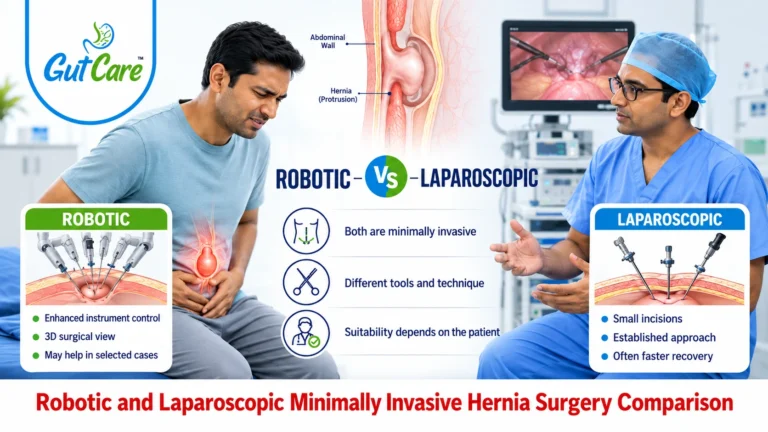
Laparoscopic hernia repair uses small incisions through which the surgeon inserts a camera and instruments.
In groin hernia surgery, common minimally invasive approaches include techniques in which the surgeon reaches the hernia from behind the abdominal wall and places mesh across the weakened area.
Potential advantages in appropriate patients may include smaller incisions and a minimally invasive recovery pathway.
However, laparoscopic repair is not automatically the best approach for every hernia.
GutCare Clinics discusses its minimally invasive approach in its laparoscopic hernia surgery in Bangalore guide.
Mesh Selection Should Be Individualised
Patients sometimes focus on whether a surgeon uses “3D mesh,” “lightweight mesh,” “biological mesh,” or another marketed term.
The more meaningful discussion involves why a particular mesh is appropriate for the patient’s hernia and where it will be placed.
Factors affecting mesh selection can include:
- Hernia location
- Defect size
- Open or laparoscopic approach
- Relationship to abdominal organs
- Tissue quality
- Whether the field is clean or contaminated
- Previous surgery
- Recurrence history
- Available evidence for the intended use
A brand name alone does not establish that one mesh is universally better or safer.
Factors That Can Affect Hernia Repair Outcomes
Hernia surgery outcomes are influenced by more than surgical mesh.
Patients may be advised to address modifiable risk factors before surgery where clinically appropriate.
Important considerations may include:
- Smoking
- Body weight
- Diabetes control
- Chronic cough
- Constipation and straining
- Heavy lifting
- Nutrition
- Previous hernia recurrence
- Wound infection risk
Preoperative optimisation can form part of a broader strategy to reduce surgical complications.
Patients seeking assessment can review GutCare Clinics’ hernia treatment services in Bangalore.
Warning Signs After Hernia Surgery
Some pain, swelling, bruising, and temporary limitation of activity can occur after hernia repair.
Medical assessment may be needed if recovery is accompanied by symptoms such as:
- Increasing rather than improving pain
- Persistent or high fever
- Increasing redness around the wound
- Pus or abnormal discharge
- Worsening swelling
- Persistent vomiting
- Severe abdominal distension
- Inability to pass stool or gas with significant abdominal symptoms
- A new or enlarging bulge
- Significant deterioration in general condition
Follow the discharge instructions provided by the surgical team, since postoperative expectations differ between operations.
An Informed Decision Before Hernia Surgery
The most useful conversation with a surgeon is not simply asking whether mesh is safe.
A better discussion considers:
- Exact type of hernia
- Size and location
- Whether surgery is needed now
- Open versus laparoscopic repair
- Mesh versus non-mesh options
- Type and position of mesh
- Expected recurrence risk
- Risk of chronic pain
- Personal medical risk factors
- Expected recovery
- Surgeon experience with the proposed technique
The FDA specifically encourages patients to discuss whether mesh will be used, the reason for choosing it, and the potential risks and benefits before undergoing hernia repair.
FAQs
Is hernia mesh safe?
Hernia mesh is widely used and is considered an established option for many hernia repairs. International guidelines support mesh-based repair for most adult groin hernias because it generally lowers recurrence. However, mesh surgery carries potential risks, including pain, infection, seroma, recurrence, adhesions, and other complications.
Is mesh necessary for every hernia operation?
No. Mesh is commonly recommended for many adult hernia repairs, but it is not mandatory in every situation. Hernia type, size, patient factors, contamination risk, surgeon expertise, and patient preference can affect the choice between mesh and non-mesh techniques.
Is hernia mesh permanent?
Many synthetic hernia meshes are designed to remain permanently in the body. Other materials may be partially or fully absorbable. Patients should ask their surgeon what type of mesh is planned and whether it is permanent.
Can hernia mesh cause chronic pain?
Chronic pain can occur after groin hernia surgery. Mesh may be one factor in some cases, but pain can also involve nerves, scar tissue, surgical fixation, recurrent hernia, and other causes. Preventing chronic postoperative pain is an important consideration in modern hernia surgery.
Can hernia mesh get infected?
Yes, mesh infection is a recognised complication, although it does not occur in every patient. The risk varies with the operation, wound conditions, patient health, and other factors. Significant mesh infection may occasionally require additional procedures.
Can hernia mesh move inside the body?
Mesh migration has been reported, but it is an uncommon complication. Proper mesh selection, positioning, fixation, surgical technique, and patient factors all contribute to the overall outcome.
Is non-mesh hernia repair safer?
Not necessarily. Mesh and non-mesh surgery each have potential advantages and disadvantages. Evidence for groin hernia repair indicates that mesh can reduce recurrence, while selected non-mesh techniques remain appropriate for certain patients when performed by experienced surgeons.
Is laparoscopic hernia mesh safe?
Laparoscopic mesh repair is an established approach for appropriate hernias. Its suitability depends on the hernia, patient health, previous surgery, and surgeon experience. As with any operation, potential complications should be discussed before surgery.
Can a hernia come back after mesh surgery?
Yes. Mesh can reduce recurrence risk but cannot guarantee that a hernia will never recur. Hernia size, tissue quality, surgical technique, smoking, obesity, wound complications, and other factors can influence recurrence.
How do I know which hernia mesh my surgeon will use?
Ask your surgeon for the mesh manufacturer, product name, material, whether it is permanent or absorbable, where it will be placed, and why it is appropriate for your repair. The FDA also recommends keeping implant information and contacting the hospital or surgeon if you need details about mesh used in previous surgery.
What should I ask my surgeon before hernia mesh surgery?
Useful questions include the type of hernia you have, why mesh is being recommended, whether non-mesh repair is reasonable, which mesh will be used, where it will be positioned, the surgeon’s experience with the technique, expected recurrence and chronic pain risks, and what symptoms after surgery should prompt medical review.
Should I avoid mesh because of hernia mesh lawsuits?
Lawsuits or problems involving specific mesh products do not establish that all hernia mesh repairs are unsafe. Mesh products differ, and outcomes also depend on patient factors and surgical technique. Discuss concerns about specific products with your surgeon and use regulatory information from sources such as the FDA rather than relying only on legal advertisements.
Conclusion
The answer to “is hernia mesh safe?” is more nuanced than a simple yes or no.
Hernia mesh is an established tool used in modern hernia surgery and, for many groin hernias, evidence shows that mesh repair reduces recurrence compared with non-mesh repair. At the same time, complications such as chronic pain, infection, seroma, adhesions, recurrence, bowel problems, and mesh-related issues can occur.
The most important decision is therefore not whether mesh is universally “good” or “bad.” It is whether a particular mesh repair is appropriate for your type of hernia, anatomy, health, and surgical situation.
Patients considering hernia surgery should understand why mesh is recommended, what type will be used, where it will be placed, whether reasonable alternatives exist, and the surgeon’s experience with the proposed repair.
For assessment and treatment options, see GutCare Clinics’ hernia treatment in Bangalore andlaparoscopic hernia surgery in Bangalore.
Medical Disclaimer: This article provides general educational information only. It does not replace individual medical advice, diagnosis, or recommendations from a surgeon who has assessed your hernia.