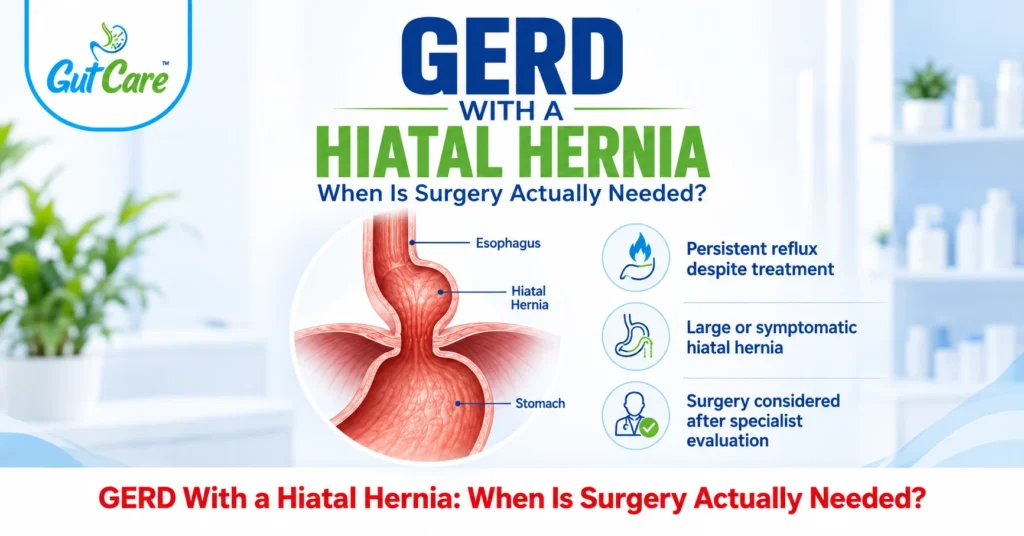
Finding out that you have both GERD and a hiatal hernia can make surgery sound inevitable. In reality, many people with a hiatal hernia never need an operation.
For patients with GERD with a hiatal hernia, surgery becomes more relevant when reflux is objectively confirmed and remains troublesome despite appropriate treatment, when there is severe reflux-related damage to the oesophagus, when the hernia is large or anatomically significant, or when the hernia itself is causing important symptoms or complications.
The presence of a hiatal hernia on an endoscopy or scan alone is usually not enough to decide on surgery.
Current American College of Gastroenterology guidance recommends antireflux surgery as a long-term option for patients who have objective evidence of GERD, particularly those with severe reflux oesophagitis, large hiatal hernias, or persistent troublesome GERD symptoms.
That means the real decision is not simply whether you have a hiatal hernia. It is whether the hernia is contributing to clinically important reflux or other problems, whether non-surgical treatment is working, and whether testing confirms that an operation is likely to address the cause of your symptoms.
GutCare Clinics also has a dedicated guide to acid reflux caused by a hiatal hernia for patients who want a broader overview of this connection.
The Connection Between GERD and a Hiatal Hernia
GERD, or gastroesophageal reflux disease, occurs when stomach contents repeatedly flow backwards into the oesophagus and cause troublesome symptoms or complications.
A hiatal hernia occurs when part of the stomach moves upward through the opening in the diaphragm where the oesophagus normally passes.
The diaphragm and the lower oesophageal sphincter together form part of the body’s natural antireflux barrier. When this anatomy is disrupted by a hiatal hernia, reflux may become easier.
However, a hiatal hernia and GERD are not identical conditions.
A person can have a small hiatal hernia without significant reflux. Another person can have severe GERD without a large hiatal hernia.
This distinction is important because surgery should be aimed at correcting a problem that has been properly identified rather than treating an incidental finding on a scan.
SAGES describes four types of hiatal hernia and notes that management depends on factors including hernia type and size, symptom burden, and whether symptoms are adequately controlled without surgery.
Sliding and Paraesophageal Hiatal Hernias
Most hiatal hernias are not anatomically identical.
| Type | Basic Anatomy | Typical Clinical Relevance |
| Type I, sliding hiatal hernia | The junction between the oesophagus and stomach moves above the diaphragm | Commonly associated with GERD |
| Type II | Part of the stomach moves through the hiatus while the gastroesophageal junction remains in its usual position | A form of paraesophageal hernia |
| Type III | Both the gastroesophageal junction and part of the stomach move above the diaphragm | Larger paraesophageal component |
| Type IV | The stomach and another abdominal organ may move through the hiatus | More complex anatomy |
SAGES defines Type I as the typical sliding hiatal hernia and Types II to IV as progressively different forms in which more of the stomach or other structures can enter the chest.
This matters because the decision to operate on a small sliding hernia associated with reflux is different from the decision-making involved in a large symptomatic paraesophageal hernia.
Most Patients Start With Non-Surgical GERD Treatment
A diagnosis of GERD with hiatal hernia does not automatically move a patient onto an operating list.
For many people, the first stage of treatment involves lifestyle measures together with acid-suppressing medication when appropriate.
Proton pump inhibitors, commonly called PPIs, are among the most effective medicines for healing reflux oesophagitis and controlling acid-related GERD symptoms.
Lifestyle management may also include weight management where appropriate, avoiding meals close to bedtime, adjusting individual dietary triggers, stopping smoking, and elevating the head of the bed for night-time symptoms.
GutCare Clinics discusses these approaches in its GERD and acid reflux treatment resource.
The presence of a hiatal hernia does not mean medicines have “failed” simply because they do not physically remove the hernia. If medication successfully controls GERD and there are no other reasons to repair the hernia, surgery may not be necessary.
The Point at Which Surgery Enters the Discussion
Surgery becomes a more meaningful option when the expected benefits of repairing the antireflux barrier outweigh the risks and limitations of continuing medical management.
Several clinical situations can move the discussion in that direction.
| Clinical Situation | Effect on Surgical Decision |
| Mild symptoms controlled with medication | Surgery often not required |
| Small incidental hiatal hernia without significant symptoms | Usually not an automatic indication for surgery |
| Objectively confirmed GERD with persistent troublesome symptoms | Surgery may be considered |
| Severe reflux oesophagitis | Makes antireflux surgery more relevant in appropriate patients |
| Large symptomatic hiatal hernia | Surgical evaluation becomes more important |
| Prominent regurgitation despite appropriate treatment | May favour evaluation for antireflux intervention when reflux is proven |
| Medication intolerance | Surgery may be considered in selected patients |
| Patient preference to avoid long-term medication | Can be part of shared decision-making, but objective confirmation of GERD remains important |
| Dysphagia, bleeding, anaemia, weight loss or other alarm features | Requires proper investigation before assuming symptoms are simply GERD |
| Paraesophageal hernia causing significant mechanical symptoms | Surgical evaluation may be appropriate even when heartburn is not the main complaint |
The ACG particularly identifies patients with severe Los Angeles grade C or D oesophagitis, large hiatal hernias, and persistent troublesome GERD symptoms as groups likely to benefit most from surgery when objective GERD is established.
Medication Failure Needs to Be Defined Carefully
One of the most common reasons patients consider surgery is the belief that their acid reflux medicine has stopped working.
That situation deserves careful evaluation.
Persistent symptoms while taking a PPI do not automatically prove that uncontrolled acid reflux is causing those symptoms.
Heartburn-like chest discomfort, regurgitation, throat symptoms, belching, swallowing problems, oesophageal motility disorders, functional heartburn, and other conditions can overlap.
This is one reason performing antireflux surgery solely because “PPIs didn’t work” can be a mistake.
If symptoms are actually being caused by something other than pathologic reflux, tightening the antireflux barrier may not solve them.
The ACG therefore emphasises careful assessment and objective evidence of reflux before invasive treatment.
Regurgitation Can Matter More Than Heartburn in Surgical Selection
Heartburn and regurgitation are both classic GERD symptoms, but they respond differently to treatment.
PPIs reduce stomach acid. They do not physically stop every episode of stomach contents moving upward.
As a result, some patients find that their burning sensation improves while troublesome regurgitation continues.
For a patient with objectively documented reflux and persistent regurgitation, restoring the mechanical antireflux barrier may be more relevant than simply increasing acid suppression.
This does not mean everyone who reports regurgitation needs surgery. The diagnosis should still be verified, particularly before an invasive procedure.
Large Hiatal Hernias Change the Decision
A small sliding hiatal hernia discovered incidentally is very different from a large hernia in which a substantial part of the stomach has moved into the chest.
Larger or paraesophageal hernias may produce symptoms that extend beyond typical heartburn.
Patients can experience post-meal pressure, chest discomfort, swallowing difficulty, early fullness, shortness of breath, regurgitation, or other mechanical symptoms depending on the anatomy.
SAGES notes that hiatal hernia management is influenced by size, type, symptoms, and failure of non-surgical symptom control. Its 2024 guideline also emphasises shared decision-making because the evidence is not equally strong for every surgical scenario.
Therefore, the size of the hernia matters, but it should not be interpreted without considering symptoms and anatomy.
Objective Testing Before GERD Surgery
One of the most important differences between routine GERD treatment and planning for antireflux surgery is the level of diagnostic certainty required.
Surgery changes anatomy permanently or semi-permanently. The treating team therefore needs confidence that reflux is actually the problem being treated.
A typical preoperative assessment may involve:
| Investigation | Purpose |
| Upper GI endoscopy | Looks for oesophagitis, Barrett’s oesophagus, narrowing, other abnormalities and signs of hiatal hernia |
| Ambulatory reflux monitoring | Measures reflux exposure and helps establish objective GERD when the diagnosis is uncertain |
| High-resolution oesophageal manometry | Evaluates oesophageal muscle function before antireflux surgery |
| Barium swallow or esophagram | Can help define anatomy, swallowing and the size/configuration of a larger hiatal hernia |
| Additional imaging | May be used depending on complex anatomy or other clinical concerns |
The ACG notes that direct reflux measurement can be particularly important when symptoms remain uncontrolled or surgery is being considered.
Endoscopy Provides More Than a Hernia Diagnosis
Upper GI endoscopy allows the doctor to examine the oesophagus and stomach directly.
It may identify erosive oesophagitis, strictures, Barrett’s oesophagus, or another explanation for symptoms.
It also helps assess a hiatal hernia, although additional testing can sometimes provide a better understanding of the anatomy.
Alarm symptoms such as worsening difficulty swallowing, gastrointestinal bleeding, unexplained weight loss, or persistent vomiting require medical evaluation rather than simply escalating home treatment for “acidity.”
GutCare Clinics’ current acid reflux treatment guide in Bangalore also highlights endoscopy and reflux testing as part of the evaluation pathway when symptoms persist or warning signs are present.
Reflux Monitoring Can Prevent the Wrong Operation
Ambulatory pH or pH-impedance testing measures reflux over an extended period.
This can be especially useful when a patient has significant symptoms but endoscopy has not already provided clear objective evidence of GERD.
A patient may feel severe heartburn but have normal oesophageal acid exposure. Conversely, another patient may have objectively abnormal reflux despite limited visible damage on endoscopy.
That difference matters enormously before surgery.
Antireflux surgery is more likely to help when the symptom being targeted genuinely relates to reflux.
Oesophageal Manometry Is Important Before Surgery
High-resolution manometry measures how the oesophagus contracts and how the oesophageal sphincters function.
ACG guidance recommends high-resolution manometry before antireflux surgery or endoscopic therapy to rule out important motility disorders such as achalasia and absent contractility.
This is not simply another test added to the checklist.
Some swallowing disorders can resemble GERD. Identifying them before surgery can change both the diagnosis and the treatment strategy.
Laparoscopic Hiatal Hernia Repair
When surgery is appropriate, many hiatal hernia operations can be performed using a minimally invasive laparoscopic approach.
The exact operation varies according to the anatomy.
A typical repair may involve returning the stomach to its proper position, reducing the hernia, restoring an adequate length of oesophagus within the abdomen where possible, and repairing the widened opening in the diaphragm.
An antireflux procedure is often performed as part of the operation.
SAGES’ current hiatal hernia guideline suggests performing fundoplication during repair of Type II, III, or IV hiatal hernias, although it describes the certainty of evidence behind that recommendation as low.
Fundoplication Restores the Antireflux Barrier
Fundoplication uses the upper part of the stomach to reinforce the junction between the oesophagus and stomach.
A complete wrap is commonly referred to as a Nissen fundoplication. Partial wraps are also used in selected situations.
The purpose is to reduce abnormal reflux while still allowing food to pass into the stomach.
The choice between different fundoplication techniques depends on factors including oesophageal function, symptoms, anatomy, and surgeon judgement.
This is another reason preoperative manometry can be important.
Surgery Has Trade-Offs
Antireflux surgery can provide meaningful symptom control for appropriately selected patients, but it should not be presented as a guaranteed permanent cure.
Potential complications or postoperative effects can include difficulty swallowing, bloating, inability or reduced ability to belch or vomit, recurrent reflux, recurrent hiatal hernia, injury to nearby structures, bleeding, infection, or the need for further treatment.
Some patients may eventually resume acid-reducing medication.
The American College of Gastroenterology’s patient guidance specifically notes that surgery is not necessarily a permanent medication-free solution for every patient and recommends evaluation by both gastroenterology and experienced reflux surgery specialists before such a decision.
A good surgical consultation should therefore discuss both what an operation may improve and what it cannot guarantee.
Barrett’s Oesophagus Does Not Automatically Mean Surgery
Barrett’s oesophagus can develop after long-term reflux and requires appropriate medical follow-up.
Its presence demonstrates that reflux has had consequences, but surgery should not be assumed to eliminate the need for Barrett’s surveillance or guarantee prevention of cancer.
Treatment decisions should consider GERD control, anatomy, symptoms and the patient’s overall clinical situation.
Patients with Barrett’s should follow the surveillance and management plan provided by their gastroenterology team regardless of whether antireflux surgery is performed.
Obesity Can Change the Surgical Strategy
Body weight can affect both GERD and hiatal hernia treatment.
Obesity increases abdominal pressure and can contribute to reflux as well as affect hernia recurrence and surgical planning.
For some patients with obesity and GERD, the most appropriate strategy may differ from standard fundoplication.
ACG guidance recognises Roux-en-Y gastric bypass as a possible option for selected patients with obesity who are candidates for that operation and accept its associated risks and lifestyle requirements.
This is a specialised decision and should not be reduced to a generic recommendation based on BMI alone.
Small Hiatal Hernias Often Do Not Need Repair
This is perhaps the most useful message for patients who have just read the words “hiatal hernia” on an endoscopy report.
A small sliding hiatal hernia does not automatically require surgery.
If symptoms are mild, reflux is controlled with appropriate treatment, and there are no significant complications or mechanical problems, conservative management may be entirely reasonable.
In such cases, the goal is to treat the disease that is actually affecting the patient rather than the imaging finding alone.
Surgery Is Most Valuable When Anatomy and Symptoms Match
Good candidates for antireflux and hiatal hernia surgery tend to have a coherent clinical picture.
There is a structural problem, symptoms compatible with that problem, and appropriate testing that supports the diagnosis.
The weakest rationale for surgery is often the opposite: vague symptoms, uncertain GERD, and a small incidental hernia.
This distinction makes preoperative investigation essential.
A properly selected patient with proven reflux and a significant hiatal hernia is very different from someone with throat discomfort, normal reflux testing and a small sliding hernia found incidentally.
A Practical Treatment Pathway
The treatment journey can be simplified into four stages.
| Stage | Typical Approach |
| GERD symptoms begin | Clinical assessment and appropriate lifestyle or medical treatment |
| Symptoms persist or warning signs appear | Endoscopy and further evaluation as indicated |
| Surgery becomes a possibility | Confirm GERD objectively and assess anatomy and oesophageal function |
| Significant hiatal hernia plus appropriate surgical indication | Individualised laparoscopic repair and antireflux strategy may be considered |
This pathway prevents surgery from becoming the default response to every hiatal hernia.
It also prevents patients with clinically important structural disease from remaining indefinitely on symptom treatment without investigating the underlying anatomy.
Selecting the Right Patient Matters More Than Selecting the Newest Procedure
GERD treatment now includes medication, conventional antireflux surgery and selected endoscopic or device-based procedures.
That does not mean every technique suits every hiatal hernia.
For example, the size of a hiatal hernia can limit suitability for certain endoscopic antireflux approaches. Anatomy needs to be considered before recommending a procedure simply because it is marketed as incisionless or newer.
The key questions before treatment are the diagnosis, anatomy and physiological cause of symptoms.
Technology comes after those questions have been answered.
GERD and Hiatal Hernia Care in Bangalore
Patients with long-standing reflux often reach surgical consultation after years of intermittent antacid or PPI use.
The purpose of specialist assessment should not be to push every patient toward an operation.
It should establish whether symptoms represent proven GERD, whether a hiatal hernia is materially contributing, whether complications are present and whether correction of the anatomy is likely to improve the problem.
GutCare Clinics currently provides information on GERD treatment in Bangalore,acid reflux evaluation, andtreatment for acid reflux associated with hiatal hernia.
Frequently Asked Questions
Does every hiatal hernia need surgery?
No. Many small sliding hiatal hernias do not need surgical repair, particularly when they cause no significant symptoms or GERD is well controlled with non-surgical treatment. Surgery becomes more relevant when symptoms, objective reflux, significant anatomy or complications justify repairing the hernia.
Does GERD with a hiatal hernia always need surgery?
No. Many patients can control GERD using appropriate lifestyle measures and medication. A hiatal hernia makes surgery more relevant in certain situations, but its presence alone does not make an operation necessary.
When is surgery recommended for GERD with a hiatal hernia?
Antireflux surgery is most strongly considered when GERD is objectively confirmed and the patient has persistent troublesome symptoms, severe reflux oesophagitis, a large hiatal hernia, or another appropriate reason for surgical treatment. The final decision requires individual assessment.
Can a hiatal hernia cause acid reflux?
Yes. A hiatal hernia can disrupt the normal relationship between the lower oesophageal sphincter and diaphragm, weakening part of the natural antireflux barrier. However, not every person with a hiatal hernia develops clinically significant GERD.
Can PPIs fix a hiatal hernia?
No. PPIs reduce stomach acid and can control GERD symptoms and heal reflux oesophagitis, but they do not physically move the stomach back through the diaphragm or repair the hiatal opening. That does not mean surgery is automatically required if medication controls the clinically important problem.
Is it better to stay on GERD medicine or have surgery?
There is no single answer for every patient. Medicines may provide excellent control for many people. Surgery can be appropriate for selected patients with objectively proven GERD and suitable anatomy. The decision should consider symptom control, oesophageal damage, hernia size, medication tolerance, testing results, surgical risks and patient preferences.
Which tests are needed before hiatal hernia surgery?
Evaluation commonly includes upper GI endoscopy and assessment of the hernia anatomy. Reflux monitoring may be necessary when GERD has not already been objectively established. High-resolution oesophageal manometry is recommended before antireflux surgery to identify major motility disorders.
Is fundoplication always performed with hiatal hernia repair?
Not in every conceivable case, but antireflux surgery is commonly combined with hiatal hernia repair when reflux is part of the clinical problem. SAGES currently suggests fundoplication during repair of Type II, III and IV hiatal hernias, while acknowledging low certainty in the supporting evidence.
Can GERD return after hiatal hernia surgery?
Yes. Surgery can substantially improve reflux in appropriately selected patients, but recurrent symptoms, recurrent hernia or future need for acid-reducing medication can occur. Patients should discuss expected long-term outcomes rather than assuming surgery guarantees permanent elimination of GERD.
Can a hiatal hernia come back after surgery?
Yes. Recurrence is possible after hiatal hernia repair. The risk depends on factors including anatomy, hernia size, tissue characteristics, surgical technique and patient factors. A recurrent anatomical hernia does not always produce recurrent symptoms.
Is laparoscopic hiatal hernia surgery major surgery?
It is commonly performed using minimally invasive techniques, but it is still an operation involving the stomach, oesophagus and diaphragm. It requires anaesthesia and carries surgical risks. “Laparoscopic” describes the access method and should not be interpreted as meaning the procedure is minor or risk-free.
Can surgery help regurgitation when PPIs do not?
It may in appropriately selected patients. PPIs reduce acidity but do not always prevent the physical movement of stomach contents into the oesophagus. When troublesome regurgitation persists and objective testing confirms reflux, antireflux intervention may be considered.
Conclusion
For someone with GERD with a hiatal hernia, the discovery of the hernia is only the beginning of the decision process.
Many small sliding hiatal hernias can be managed without surgery. If symptoms respond well to appropriate GERD treatment and there are no important complications or mechanical problems, an operation may provide little additional benefit.
Surgery becomes more relevant when GERD is objectively established and remains troublesome, when severe reflux-related oesophageal damage is present, when a large or symptomatic hiatal hernia is affecting anatomy, or when other clinical factors make repair appropriate. Current ACG recommendations particularly support considering antireflux surgery in patients with objective GERD who have severe oesophagitis, large hiatal hernias or persistent troublesome symptoms.
The most important step before surgery is therefore confirming that the symptoms, reflux testing and anatomy tell the same story.
For evaluation in Bengaluru, patients can learn more about acid reflux treatment at GutCare Clinics and the clinic’s existing guide to acid reflux caused by hiatal hernia.
Medical Disclaimer: This article provides general educational information and does not replace diagnosis or personalised advice from a gastroenterologist or surgeon. New or severe chest pain, gastrointestinal bleeding, progressive difficulty swallowing, unexplained weight loss or other concerning symptoms require prompt medical assessment.