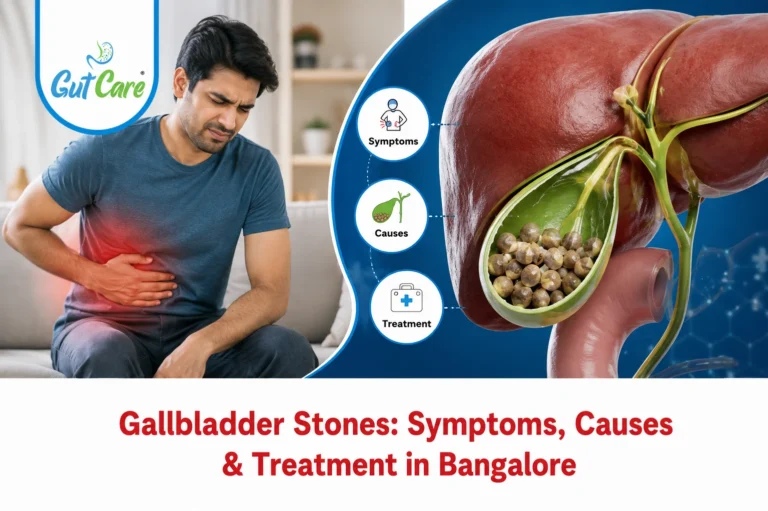
Having gallstones does not automatically mean you need ERCP before gallbladder surgery.
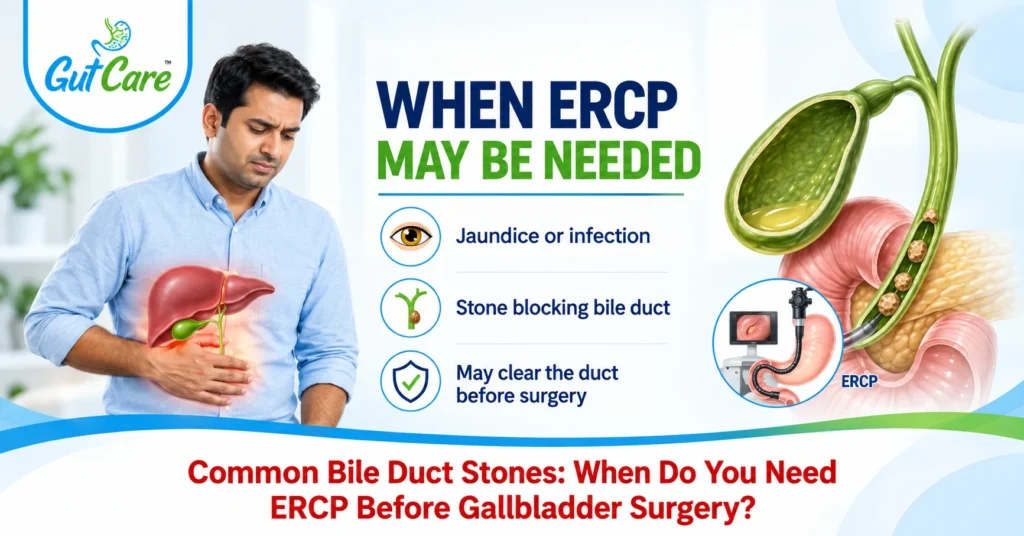
ERCP is mainly considered when a stone has moved from the gallbladder into the common bile duct, a condition called choledocholithiasis, or when there is strong evidence that a bile duct stone is causing obstruction or infection.
For patients at intermediate risk, doctors may first use a non-invasive MRI-based test called MRCP or an endoscopic ultrasound called EUS to confirm whether a common bile duct stone is actually present. Patients with convincing evidence of a duct stone may proceed directly to therapeutic ERCP. This approach helps avoid unnecessary ERCP because the procedure, although highly useful, carries recognised risks.
If you have already been diagnosed with gallstones, you can also read GutCare Clinics’ guide to gallbladder stone surgery in Bangalore for an overview of diagnosis, laparoscopic surgery, and recovery. GutCare’s current gallstone content also identifies MRCP as an additional test when a bile duct stone is suspected.
Quick Answer: When Is ERCP Needed Before Gallbladder Surgery?
ERCP before gallbladder surgery is usually considered when there is a confirmed common bile duct stone or a high probability of one. Examples include a bile duct stone visible on imaging, ascending cholangitis, or certain combinations of markedly abnormal bilirubin and bile duct dilation. Intermediate-risk patients are usually evaluated further with MRCP, EUS, or operative imaging before ERCP.
What Are Common Bile Duct Stones?
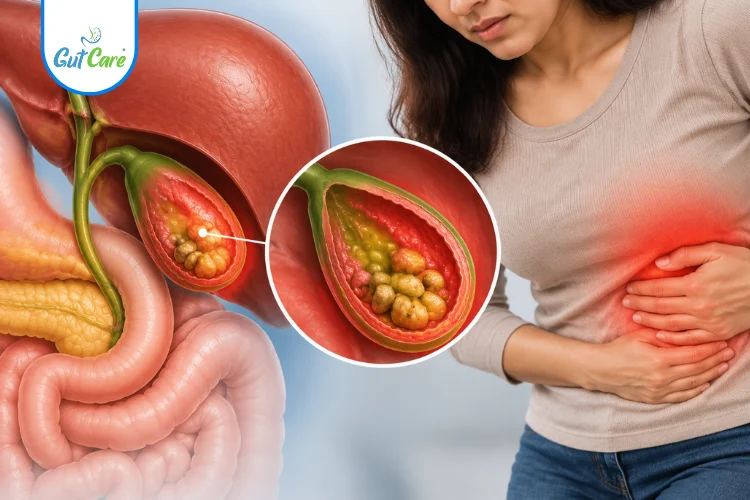
The gallbladder stores bile produced by the liver. Bile travels from the liver and gallbladder through bile ducts before entering the small intestine.
Most gallstones remain inside the gallbladder. However, a stone can leave the gallbladder and enter the common bile duct, the main channel carrying bile toward the intestine.
A stone in this duct is called a common bile duct stone, or CBD stone. The medical term is choledocholithiasis.
This distinction matters because treatment for a stone inside the gallbladder is different from treatment for a stone obstructing the common bile duct.
Gallbladder stones are commonly treated by removing the gallbladder when surgery is clinically indicated. A common bile duct stone often needs to be cleared from the duct as part of the treatment plan, frequently with ERCP. European Society of Gastrointestinal Endoscopy guidance recommends extraction of identified common bile duct stones in patients who are fit enough to undergo the intervention.
Gallbladder Stones vs Common Bile Duct Stones
| Feature | Gallbladder Stones | Common Bile Duct Stones |
| Location | Inside the gallbladder | Inside the common bile duct |
| Medical term | Cholelithiasis | Choledocholithiasis |
| Can block bile flow? | Sometimes, depending on location | Yes, particularly when lodged in the duct |
| May cause jaundice? | Less typical unless a duct becomes obstructed | Yes |
| Usual imaging starting point | Abdominal ultrasound | Ultrasound plus liver tests, then MRCP/EUS if needed |
| ERCP routinely required? | No | May be required when a CBD stone is confirmed or highly likely |
| Gallbladder surgery | Often laparoscopic cholecystectomy when indicated | Often still required after duct clearance when gallbladder stones are the source |
GutCare Clinics explains laparoscopic gallbladder removal in more detail in its laparoscopic cholecystectomy surgery guide.
What Symptoms Can Common Bile Duct Stones Cause?
A common bile duct stone may cause abdominal pain similar to gallstone pain, but duct obstruction can also produce symptoms that deserve prompt medical assessment.
Possible symptoms include upper abdominal pain, nausea or vomiting, yellowing of the skin or eyes, dark urine, pale stools, fever, and chills.
Jaundice can occur when bile cannot flow normally through the duct. Fever, abdominal pain, and jaundice together can raise concern for acute cholangitis, an infection associated with obstruction of the bile duct.
GutCare’s own guide to complications of gallstones discusses both cholangitis and gallstone-related pancreatitis as potential complications of gallstone disease.
Severe abdominal pain with fever, chills, jaundice, confusion, or significant weakness should not be managed by waiting for a routine outpatient appointment. Urgent medical assessment may be required, particularly when cholangitis or another gallstone complication is suspected. ESGE guidance recommends biliary drainage timing according to the severity of acute cholangitis, with urgent intervention for severe disease.
How Do Doctors Check for Common Bile Duct Stones?
The decision to perform ERCP should usually start with an assessment of how likely it is that a common bile duct stone is actually present.
ESGE recommends liver function tests and abdominal ultrasonography as initial diagnostic steps when common bile duct stones are suspected. The results help establish whether further testing or treatment is needed.
A typical assessment may involve the following:
| Test | What It Helps Assess |
| Liver blood tests | Signs that bile flow may be obstructed |
| Bilirubin | Can rise when bile drainage is blocked |
| Abdominal ultrasound | Gallstones, bile duct size, and sometimes duct stones |
| MRCP | Detailed MRI images of the biliary and pancreatic ducts |
| EUS | High-resolution ultrasound performed from inside the digestive tract |
| ERCP | Primarily used to treat confirmed or highly likely duct obstruction |
| Intraoperative cholangiography | Can examine the bile ducts during gallbladder surgery |
The exact sequence depends on the patient’s symptoms, laboratory results, ultrasound findings, medical history, and local expertise.
What Is MRCP?
MRCP, or magnetic resonance cholangiopancreatography, is a non-invasive MRI technique used to produce detailed images of the bile ducts and pancreatic ducts.
It does not require an endoscope to be passed into the bile duct.
MRCP can be particularly useful when a patient has possible evidence of a common bile duct stone but the probability is not high enough to justify proceeding immediately to ERCP.
For example, GutCare’s current gallbladder surgery guidance lists MRCP as an additional investigation when bile duct stones are a concern.
What Is EUS?
EUS, or endoscopic ultrasound, combines endoscopy with high-frequency ultrasound to examine structures close to the digestive tract, including the bile duct.
ASGE guidance supports either EUS or MRCP for patients at intermediate risk of choledocholithiasis, with the final choice influenced by factors such as availability, patient characteristics, and specialist expertise.
This is useful because many patients suspected of having a bile duct stone do not need an invasive ERCP simply to determine whether a stone is present.
What Is ERCP?
ERCP stands for endoscopic retrograde cholangiopancreatography. It is an endoscopic procedure that allows a specialist to access the bile duct and treat problems such as obstructing common bile duct stones.
During ERCP, an endoscope is passed through the mouth into the upper digestive tract until it reaches the opening of the bile and pancreatic ducts in the small intestine. Contrast imaging and specialised instruments can then be used to identify and treat obstruction.
When a stone is found, the doctor may enlarge the duct opening with a sphincterotomy and remove the stone using specialised devices.
GutCare Clinics’ existing gallstone treatment options guide also describes ERCP as a procedure combining endoscopy and fluoroscopy to treat bile duct problems and remove stones causing obstruction.
Does Everyone With Gallstones Need ERCP Before Surgery?
No. Most patients with ordinary gallbladder stones do not automatically need ERCP before laparoscopic cholecystectomy.
ERCP is not intended to be a routine preoperative test for every person with gallstones.
One reason is that ERCP has meaningful procedure-related risks. The ASGE guideline notes that ERCP used for bile duct stone treatment is associated with major adverse events in approximately 6 to 15 percent of cases in the evidence reviewed. These potential complications are one reason specialists try to avoid purely diagnostic ERCP when MRCP, EUS, or other appropriate testing can answer the diagnostic question less invasively.
This does not mean ERCP is unsafe or inappropriate. It means that the benefit should justify the risk.
Who Is Considered High Risk for a Common Bile Duct Stone?
ASGE risk stratification identifies specific findings that can place a patient in a high-risk category where ERCP may be appropriate without additional diagnostic testing.
The high-risk features include:
| High-Risk Finding | Why It Matters |
| Common bile duct stone seen on ultrasound or cross-sectional imaging | The stone has already been demonstrated |
| Clinical ascending cholangitis | Obstruction plus infection can require urgent drainage |
| Total bilirubin above 4 mg/dL together with a dilated common bile duct | The combination raises the probability of an obstructing CBD stone |
In the ASGE guideline, bile duct dilation is defined in this context as more than 6 mm in adults who have not undergone cholecystectomy, with a different threshold after gallbladder removal. Patients meeting high-risk criteria may proceed directly to ERCP when clinically appropriate.
These criteria should be interpreted by a doctor rather than used by patients to diagnose themselves from a laboratory report.
What If Your Risk of a Bile Duct Stone Is Intermediate?
This is where MRCP and EUS become especially valuable.
ASGE classifies findings such as abnormal liver biochemical tests, age above 55 years, or a dilated common bile duct as intermediate-risk predictors when high-risk criteria are absent. Rather than proceeding automatically to ERCP, these patients can be investigated with EUS, MRCP, intraoperative cholangiography, or intraoperative ultrasound according to clinical circumstances.
This approach reduces unnecessary invasive procedures while still identifying patients who need bile duct treatment.
A Simple ERCP Decision Pathway
| Clinical Situation | Typical Next Step |
| Gallstones but no signs suggesting CBD stones | Gallbladder surgery may proceed without preoperative ERCP, depending on clinical assessment |
| Intermediate probability of CBD stones | MRCP, EUS, or suitable operative bile duct imaging |
| CBD stone confirmed on imaging | Therapeutic ERCP or another duct-clearing strategy |
| Ascending cholangitis | Urgent assessment and biliary drainage, often using ERCP |
| CBD stone successfully removed by ERCP | Gallbladder surgery is usually still considered if gallbladder stones caused the problem |
This is a simplified educational pathway. Individual treatment may differ.
Why Is the Gallbladder Still Removed After ERCP?
This is one of the most important questions patients ask.
ERCP removes stones from the bile duct, but it does not usually remove the gallbladder or eliminate gallstones remaining inside it.
If the gallbladder is the source of the stones, simply clearing the common bile duct can leave the patient at risk of another gallstone entering the duct or causing another gallbladder-related event.
This is why patients treated for choledocholithiasis often undergo laparoscopic cholecystectomy after ERCP when they are suitable surgical candidates.
ESGE recommends laparoscopic cholecystectomy within two weeks after ERCP in patients treated for choledocholithiasis to reduce recurrent biliary events and the risk of conversion during surgery.
The best timing for an individual patient depends on their condition, whether infection or pancreatitis is present, other illnesses, and the treating team’s assessment.
Can ERCP and Gallbladder Surgery Be Done During the Same Admission?
Yes, treatment of the bile duct and gallbladder can sometimes take place during the same hospital admission.
The exact sequence varies between hospitals.
One approach is ERCP first to clear a confirmed common bile duct stone, followed by laparoscopic cholecystectomy.
Other centres with suitable expertise may use surgical exploration of the common bile duct, intraoperative ERCP, or other coordinated approaches.
ASGE recognises either preoperative or postoperative ERCP, or laparoscopic treatment, depending on local surgical and endoscopic expertise in patients at high risk or with a positive intraoperative cholangiogram.
The important point is that there is not one mandatory sequence for every patient.
What Are the Risks of ERCP?
ERCP can provide major benefit when a bile duct needs treatment, but patients should understand that it is more invasive than MRCP.
Recognised complications include pancreatitis after ERCP, bleeding, infection, perforation, and complications related to sedation or the procedure.
ASGE cites an overall major adverse-event risk of approximately 6 to 15 percent in ERCP treatment for bile duct stones, although an individual’s risk can differ considerably according to the procedure and clinical circumstances.
This risk-benefit balance is why current practice generally reserves ERCP for patients in whom treatment is likely to be required rather than using it routinely as the first diagnostic investigation.
What If the Stone Is Difficult to Remove With Standard ERCP?
Some common bile duct stones are more difficult to remove because of their size, position, number, or surrounding anatomy.
Advanced endoscopic techniques may be considered in these cases.
ESGE recommends limited sphincterotomy combined with large-balloon papillary dilation as a first-line approach for difficult CBD stones. It also supports cholangioscopy-assisted electrohydraulic or laser lithotripsy for selected difficult stones. When stones cannot immediately be removed but biliary drainage is required, temporary plastic stenting may be used.
The best approach depends on stone characteristics and available expertise.
ERCP vs MRCP: What Is the Difference?
| Feature | MRCP | ERCP |
| Full name | Magnetic resonance cholangiopancreatography | Endoscopic retrograde cholangiopancreatography |
| Type | MRI-based imaging | Endoscopic procedure |
| Main role | Diagnosis | Primarily treatment |
| Can detect CBD stones? | Yes | Yes |
| Can remove CBD stones? | No | Yes |
| Requires endoscope? | No | Yes |
| Useful for intermediate-risk patients? | Often | Usually avoided as a purely diagnostic test |
| Can place a stent? | No | Yes |
The practical difference is straightforward: MRCP looks at the bile ducts, while ERCP can enter and treat them.
ERCP vs Gallbladder Surgery
ERCP and gallbladder surgery solve different problems.
ERCP is designed to clear or drain the bile duct. Laparoscopic cholecystectomy removes the gallbladder, which may contain the stones that caused the duct blockage in the first place.
Therefore, ERCP should not normally be viewed as an alternative to gallbladder removal when gallbladder surgery is otherwise indicated.
Patients wanting to understand the operation itself can read GutCare’s complete guide to laparoscopic cholecystectomy.
FAQs
1. Do you always need ERCP before gallbladder surgery?
No. ERCP is not routinely needed before every gallbladder operation. It is mainly used when common bile duct stones are confirmed or strongly suspected. Intermediate-risk patients may undergo MRCP, EUS, or suitable intraoperative testing before a decision about ERCP is made.
2. Can an ultrasound detect common bile duct stones?
Ultrasound is an important initial test and can sometimes identify a bile duct stone or a dilated bile duct. However, if suspicion remains despite inconclusive ultrasound findings, MRCP or EUS may be used to investigate further. ESGE recommends liver tests and abdominal ultrasound as the initial diagnostic steps in suspected CBD stones.
3. What is the difference between gallstones and common bile duct stones?
Gallstones are stones located in the gallbladder. Common bile duct stones are stones located in the duct that carries bile toward the intestine. A bile duct stone can obstruct bile flow and may lead to jaundice, cholangitis, or pancreatitis.
4. Can a common bile duct stone pass on its own?
Some stones may pass spontaneously, but this cannot safely be assumed when choledocholithiasis is suspected or confirmed. A retained stone can obstruct the bile duct and lead to significant complications. Treatment should be based on clinical assessment and appropriate imaging. ESGE recommends extraction of identified CBD stones in suitable patients.
5. Is ERCP painful?
ERCP is normally performed with sedation or anaesthesia according to the centre’s protocol, so patients should discuss what to expect with their endoscopy team. Discomfort afterward varies, and the procedure also carries specific risks that should be explained as part of informed consent.
6. Is ERCP surgery?
ERCP is an endoscopic procedure rather than traditional abdominal surgery. An endoscope is passed through the mouth into the digestive tract, allowing the specialist to access and treat the bile duct without making the abdominal incisions used for gallbladder surgery.
7. How soon after ERCP should the gallbladder be removed?
The timing depends on the patient’s condition. ESGE recommends laparoscopic cholecystectomy within two weeks after ERCP for patients treated for common bile duct stones when appropriate, with the aim of reducing recurrent biliary events.
8. Can gallstones return after ERCP?
ERCP clears stones from the bile duct but does not remove stones remaining inside the gallbladder. If the gallbladder remains in place, additional gallstone-related events can occur. This is why gallbladder removal is commonly considered after duct clearance in suitable patients.
9. What happens if a common bile duct stone is not removed?
A retained CBD stone can obstruct bile flow and may lead to complications such as jaundice, cholangitis, or gallstone pancreatitis. GutCare Clinics also discusses these complications in its guide to gallstone complications.
10. Is MRCP better than ERCP?
They serve different purposes. MRCP is a non-invasive imaging test that can help determine whether a bile duct stone is present. ERCP is invasive but allows the doctor to treat the obstruction and remove stones. For intermediate-risk patients, MRCP or EUS is often used before deciding whether therapeutic ERCP is necessary.
11. Does jaundice from gallstones mean I need ERCP?
Jaundice can indicate bile duct obstruction, but it does not by itself determine the treatment. Doctors consider blood tests, ultrasound findings, bile duct size, symptoms, and additional imaging before deciding whether ERCP is required.
12. Is ERCP an emergency for cholangitis?
Acute cholangitis associated with an obstructed bile duct can require urgent biliary drainage. ESGE recommends timing according to disease severity, including very early drainage in severe cases with septic shock. This situation requires hospital assessment rather than routine outpatient management.
When Should You Seek Medical Attention?
Gallstones should be medically assessed when symptoms become persistent or severe, particularly when pain is accompanied by jaundice, fever, chills, repeated vomiting, dark urine, pale stools, or worsening illness.
Jaundice together with fever and significant abdominal pain may indicate bile duct obstruction complicated by infection and warrants prompt medical evaluation.
If imaging has already shown gallstones and your doctor suspects a common bile duct stone, the key question is not simply, “Do I need gallbladder surgery?” It is also, “Does my bile duct need to be evaluated or cleared before surgery?”
For more information about surgical treatment, see GutCare Clinics’ gallbladder stone surgery in Bangalore guide.
Conclusion
Common bile duct stones require a different treatment strategy from stones confined to the gallbladder. If a stone has entered the common bile duct, the medical team needs to determine whether it should be removed before, during, or occasionally after gallbladder surgery.
ERCP before gallbladder surgery is most appropriate when a bile duct stone is confirmed or when clinical findings place a patient at high risk of choledocholithiasis. Patients with intermediate-risk findings can often undergo MRCP, EUS, or intraoperative imaging first, avoiding an unnecessary invasive ERCP.
When ERCP successfully clears a stone from the bile duct, gallbladder surgery may still be necessary because the gallbladder can remain the source of future stones. ESGE recommends timely laparoscopic cholecystectomy following ERCP for choledocholithiasis in suitable patients.
If you have gallstones, jaundice, abnormal liver tests, or an imaging report suggesting a dilated common bile duct or CBD stone, discuss the findings with an appropriately qualified gastrointestinal specialist. GutCare Clinics provides assessment and surgical care for gallbladder stones in Bangalore.
Medical Disclaimer: This article provides general educational information and does not diagnose a medical condition or replace individual medical advice. ERCP and gallbladder surgery decisions depend on symptoms, blood tests, imaging findings, medical history, and specialist assessment.