Medically reviewed by Dr. Yuvraj Singh Gehlot, GI, Laparoscopic and Colorectal Surgeon, Gut Care Clinics
The acupressure points for piles are LI4 (Hegu) on the hand, ST36 (Zusanli) below the knee, BL57 (Chengshan) on the calf, GV20 (Baihui) on the crown of the head, and CV1 (Huiyin) at the perineum. Press each gently for 1 to 2 minutes, once or twice a day. Acupressure may help ease discomfort, but it does not cure piles. See a doctor if you notice bleeding or pain lasting more than a week.
Piles (hemorrhoids) can cause pain, itching, swelling and bleeding, and they often come back. Many people look for gentle, drug-free ways to ease the discomfort, and acupressure is one of the most searched options. This guide explains where the main points are, how to press them, and what acupressure can and cannot do.
Need expert care for piles? Book a consultation with our specialists at Gut Care Clinics: 08431550550
What are acupressure points for piles?
Acupressure comes from Traditional Chinese Medicine (TCM). It involves applying steady pressure to specific points on the body, which TCM describes as lying along “meridians.” The points used for piles are chosen to support bowel movement, relaxation and circulation. These are the common contributors to piles discomfort.
Scientific evidence for acupressure in piles is limited. Some people find it helps them relax and feel more comfortable, but it is best seen as a complement to diet, hydration and medical care, not a replacement.
How Does Acupressure Help With Piles?
The magic lies in pressure and consistency. When you activate acupressure points for piles, you’re not just pressing skin—you’re stimulating nerves, soft tissues, and even vascular flow around affected areas.
Here’s how acupressure helps:
- Improves blood circulation: Boosts flow to the rectal area to reduce swelling.
- Relieves constipation: Stimulates the intestines to move waste more efficiently.
- Reduces inflammation: Helps calm inflamed tissues naturally.
- Eases pain and itching: Blocks pain signals and calms irritated nerves.
- Lowers stress: Chronic stress can worsen piles—acupressure lowers cortisol levels.
While it’s not a magic bullet, regular sessions can be a game-changer for anyone looking for non-surgical piles relief. It’s especially useful when used alongside dietary and lifestyle changes.
Best Acupressure Points for Piles Relief
Here are some of the most effective acupressure points for piles that therapists often target:
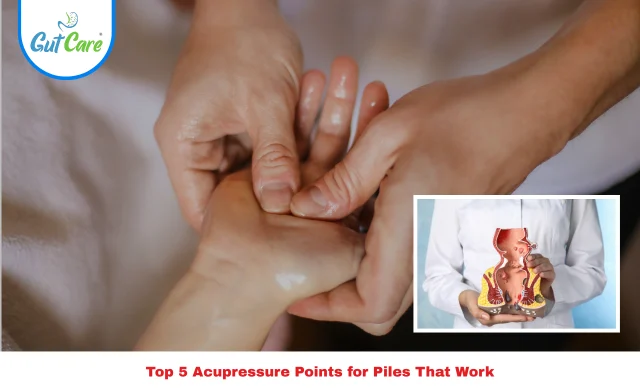
1. Large Intestine 4 (LI4) – Hegu
Location: On the back of the hand, in the fleshy web between the thumb and index finger. To find it, press the thumb against the index finger and look for the highest point of the muscle bulge.
How to press: Use the thumb of your other hand to press firmly, but not painfully, into the point. Hold for 1 to 2 minutes while breathing slowly, then switch hands.
Why it’s used: LI4 is one of the most widely used points for pain and for supporting bowel movement, which is why it is the most popular answer to “acupressure points for piles in hand.”
Caution: Avoid this point during pregnancy.
2. Perineum (CV1) – Huiyin
Location: The area between the anus and the genitals.
How to press: Only use this if you are comfortable and your piles are not painful, swollen or bleeding. Wash your hands first and use gentle pressure with a clean cloth for up to 1 minute. Skip this point if it causes any discomfort, and ask a trained therapist or doctor before trying it.
3. Stomach 36 (ST36) – Zusanli
Location: About four finger-widths below the kneecap, one finger-width outside the shinbone, on the outer leg.
How to press: Sit comfortably and press with your thumb for 1 to 2 minutes on each leg. Mild soreness or tingling is normal.
Why it’s used: It is a key point for digestion and for easing bloating, which may help with regular bowel movements.
4. Bladder 57 (BL57) – Chengshan
Location: In the center of the calf muscle, roughly halfway between the back of the knee and the heel, where the muscle narrows.
How to press: Sit or lie down with your leg stretched out and press with both thumbs for 1 to 2 minutes per leg.
Why it’s used: This point is traditionally linked with the lower back and rectal area, and is the point most often named in TCM for piles discomfort.
5. Governing Vessel 20 (GV20) – Baihui
Location: At the top of the head, on the midline, roughly in line with the tips of the ears.
How to press: Press gently with two fingers in small circles for 1 to 2 minutes, seated or lying down.
Why it’s used: GV20 is used for stress relief. Stress and tension can worsen digestion and straining, which affect piles.
Traditional Chinese Medicine and Piles: A Holistic View
Acupressure is only one aspect of Traditional Chinese Medicine (TCM). TCM views piles as a symptom of imbalances—often linked to liver heat, poor spleen function, or stagnation of Qi in the intestines.
This holistic lens means a therapist might combine acupressure with:
- Herbal remedies
- Dietary recommendations
- Breathing techniques
- Massage (Tui Na)
So if you’re serious about natural treatment for piles, acupressure works best as part of a broader wellness plan.
Acupressure vs acupuncture for piles
Acupressure uses finger pressure and no needles, so people can do it themselves at home. Acupuncture uses thin needles and is done by a trained practitioner. Both are complementary approaches. Neither has been proven to cure piles, and neither should delay medical treatment.
How Long Does It Take to See Results?
Consistency is key. Some patients report reduced itching and pain after a few sessions. Others may take a few weeks to feel substantial improvement.
Unlike creams or painkillers, acupressure points for piles offer deeper, long-lasting relief by addressing the root cause—not just the surface symptoms.
Can You Do Acupressure at Home?
Yes! One of the best parts about acupressure is that you don’t always need a specialist. Once you learn where the pressure points are, you can apply gentle pressure at home using your hands or a rounded tool.
However, it’s wise to consult a trained therapist first, especially if you have internal piles, bleeding, or chronic digestive issues. And never apply pressure to broken or severely inflamed skin.
How to do acupressure safely at home
- Wash your hands and sit or lie in a relaxed position.
- Use firm but comfortable pressure. It should never be sharp or painful.
- Hold each point for 1 to 2 minutes, breathing slowly and deeply.
- Repeat once or twice a day, for a total of 5 to 10 minutes.
- Never press on open wounds, bleeding areas or swollen veins.
- Stop if you feel sharp pain, dizziness or nausea.
- Avoid acupressure during pregnancy unless your doctor approves.
Final Thoughts: A Gentle Yet Powerful Remedy
If you’ve been dealing with recurring hemorrhoids and are tired of chemical creams or surgical options, acupressure points for piles might just be the natural solution your body’s been waiting for.
It’s safe, non-invasive, and rooted in centuries-old wisdom. More importantly, it gives you a hands-on way to take control of your health—without relying solely on prescriptions or procedures.
As with all holistic treatments, results come with consistency, care, and a willingness to listen to your body. So why not press pause on piles the natural way—literally?
Visit Gutcare Clinics For Expert Care!
5 FAQs on Acupressure Points for Piles
1. What are the best acupressure points for piles?
The points most often used are LI4 (hand), ST36 (below the knee), BL57 (calf), GV20 (crown of the head) and, optionally, CV1 (perineum). They are used to support digestion, relaxation and comfort.
2. Which acupressure point for piles is in the hand?
LI4 (Hegu), in the fleshy web between your thumb and index finger. Press it for 1 to 2 minutes on each hand. Avoid it during pregnancy.
3. Does acupressure cure piles?
No. Research is limited, and acupressure may only help ease discomfort. It works best alongside a high-fiber diet, hydration and, when needed, medical treatment.
4. Can I do acupressure for piles at home?
Yes, for the arm, leg and head points, using gentle pressure. If you have bleeding, severe pain or internal piles, see a doctor first.
5. How often should I do acupressure for piles?
Once or twice a day, for 1 to 2 minutes per point, is usually enough. More pressure is not better, so stop if it hurts.
6. Is acupressure safe during pregnancy?
Not without medical advice. Some points, including LI4, are usually avoided in pregnancy, so ask your doctor first.
7. What is the difference between acupressure and acupuncture for piles?
Acupressure uses finger pressure and can be done at home. Acupuncture uses needles and must be done by a trained practitioner.
8. When should I see a doctor for piles?
If you have bleeding, severe pain, a lump that won’t settle, or symptoms lasting over a week.