Persistent heartburn is often treated as a simple digestive problem. But when acid reflux continues for years, repeated exposure to stomach acid can damage the lining of the esophagus. In some people, this can lead to a condition called Barrett’s esophagus, which is associated with an increased risk of esophageal cancer.
The important point is that having acid reflux does not mean you will develop cancer. Most people with reflux do not develop Barrett’s esophagus, and most people with Barrett’s do not develop cancer. However, understanding the connection can help you recognize when persistent reflux needs medical assessment.
At Gutcare Clinics in Bangalore, understanding the cause of ongoing digestive symptoms is an important part of appropriate gastroenterology care.
If you have persistent heartburn, acid regurgitation or difficulty swallowing, consider discussing your symptoms with a gastroenterologist rather than relying only on long-term self-medication.
Book an appointment Today!
What Is Barrett’s Esophagus?
Barrett’s esophagus is a condition in which the normal lining of the lower oesophagus changes after prolonged exposure to refluxed stomach contents.
Normally, the oesophagus has a lining designed to handle food and liquids passing through it. Repeated acid and stomach-content exposure can cause inflammation and cellular changes. Over time, some people develop the type of lining associated with Barrett’s esophagus.
Barrett’s itself is not cancer.
However, it is considered a precancerous condition because certain cellular changes can increase the likelihood of developing oesophageal adenocarcinoma, a type of oesophageal cancer.
The risk is not the same for everyone. Doctors consider factors such as whether dysplasia is present, the extent of Barrett’s tissue and the individual’s overall risk profile.
How Is Acid Reflux Linked to Barrett’s Esophagus?
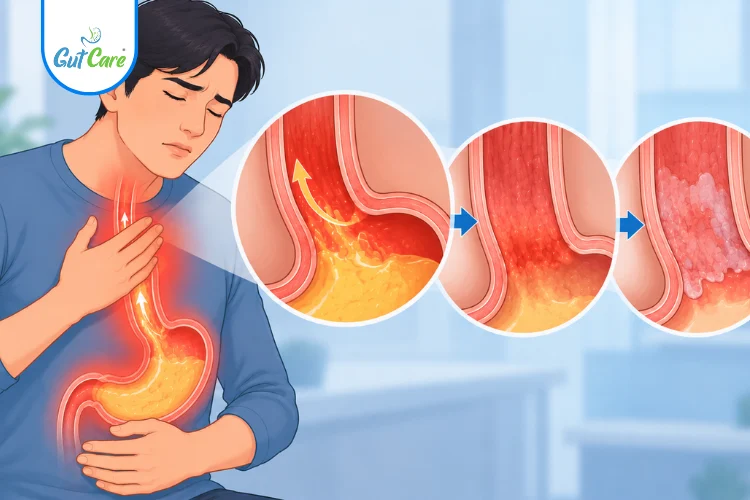
Acid reflux happens when stomach contents flow backwards into the oesophagus. Occasional reflux is common, but frequent or persistent reflux may be diagnosed as gastro-oesophageal reflux disease, or GERD.
Repeated reflux can cause inflammation and injury to the oesophageal lining.
In some people, the body responds by replacing the normal lining with a different type of tissue that is better adapted to the repeated exposure. This change is known as Barrett’s esophagus.
The pathway can therefore be understood as:
Chronic reflux → repeated oesophageal irritation → cellular changes → Barrett’s esophagus → increased cancer risk in a small proportion of people
This does not mean that every person with GERD follows this pathway. Many people with long-term reflux never develop Barrett’s esophagus.
Does Barrett’s Esophagus Mean You Have Cancer?
No.
This is one of the most important distinctions to understand.
Barrett’s esophagus is a change in the oesophageal lining, not a diagnosis of cancer. The presence or absence of dysplasia, which refers to abnormal cellular changes, helps doctors determine the level of concern.
Barrett’s may be described as:
- Non-dysplastic Barrett’s: Barrett’s tissue without precancerous cellular abnormalities.
- Low-grade dysplasia: More significant abnormal cellular changes.
- High-grade dysplasia: More advanced abnormal cellular changes with a higher risk of progression.
People with Barrett’s esophagus may therefore require periodic monitoring, while some patients with dysplasia may be considered for endoscopic treatment.
The American College of Gastroenterology’s clinical guideline on Barrett’s esophagus provides detailed recommendations on diagnosis, surveillance and treatment.
What Are the Symptoms of Barrett’s Esophagus?
Barrett’s esophagus itself often does not cause specific symptoms.
Many people discover they have it while being investigated for long-standing GERD or reflux symptoms.
Possible symptoms associated with the underlying reflux include:
- Frequent heartburn
- Acid or sour-tasting fluid coming into the mouth
- Burning discomfort behind the breastbone
- Regurgitation after meals
- Symptoms that worsen when lying down
- Chronic cough or throat irritation in some people
- Difficulty swallowing
It is important not to assume that persistent heartburn is harmless simply because it has been present for years.
Warning Signs That Need Medical Assessment
Certain symptoms should be evaluated promptly, particularly when they are new or worsening:
- Difficulty or pain when swallowing
- Unexplained weight loss
- Vomiting that persists
- Vomiting blood
- Black or tarry stools
- Persistent chest or upper abdominal discomfort
- Symptoms of anaemia or unusual fatigue
These symptoms can have many possible causes, and they do not automatically indicate cancer. However, they should not be ignored.
Who May Be at Higher Risk of Barrett’s Esophagus?
Barrett’s is more commonly associated with people who have long-standing or frequent reflux, but GERD alone does not determine who will develop it.
Risk may be influenced by factors such as:
- Long-standing GERD
- Frequent or severe reflux symptoms
- Excess body weight, particularly abdominal obesity
- Smoking
- Older age
- Male sex
- A family history of Barrett’s esophagus or oesophageal cancer
Risk assessment should be individualised. Not everyone with heartburn requires an endoscopy, and screening recommendations can vary according to a person’s risk factors.
How Is Barrett’s Esophagus Diagnosed?
The main test used to diagnose Barrett’s esophagus is an upper gastrointestinal endoscopy.
During an endoscopy, a flexible camera is passed through the mouth to examine the oesophagus and stomach. If the doctor sees tissue that may represent Barrett’s changes, small tissue samples called biopsies can be collected.
A pathologist then examines these samples under a microscope.
This is important because the appearance of the oesophagus alone is not enough to determine whether Barrett’s is present or whether dysplasia has developed.
The National Institute of Diabetes and Digestive and Kidney Diseases (NIDDK) provides further information about GERD and its complications.
If persistent reflux symptoms are affecting your daily life, a gastroenterology consultation can help determine whether further evaluation, including endoscopy, is appropriate.
How Is Barrett’s Esophagus Managed?
Treatment depends on the findings, particularly whether dysplasia is present.
Managing Acid Reflux
Doctors may recommend lifestyle measures and medicines to control reflux and reduce acid exposure.
Depending on the individual, measures may include:
- Maintaining a healthy weight where appropriate
- Avoiding meals close to bedtime
- Identifying foods or drinks that consistently trigger symptoms
- Limiting smoking and alcohol exposure
- Elevating the head of the bed when nighttime reflux is a problem
- Using acid-suppressing medication when prescribed
Proton pump inhibitors, commonly known as PPIs, are frequently used to control GERD and may also be recommended in people with Barrett’s esophagus.
Medication should be taken according to medical advice rather than continued indefinitely without review.
Surveillance for Barrett’s Esophagus
People with non-dysplastic Barrett’s may be advised to undergo periodic endoscopic surveillance.
The timing depends on factors such as the length of Barrett’s segment, biopsy findings and the individual’s risk profile.
The purpose of surveillance is to identify significant cellular changes early, when they may be more amenable to treatment.
Endoscopic Treatment for Dysplasia
When Barrett’s contains significant dysplasia, endoscopic therapies may be considered.
Depending on the findings, treatment can include techniques that remove abnormal tissue or destroy the affected lining so that healthier tissue can grow back.
The appropriate approach depends on the pathology results and should be determined by a specialist experienced in managing Barrett’s esophagus.
Can Barrett’s Esophagus Be Prevented?
There is no guaranteed way to prevent Barrett’s esophagus, but controlling persistent reflux and addressing modifiable risk factors may be beneficial for overall oesophageal and digestive health.
Practical measures include:
- Do not ignore frequent or worsening reflux.
- Avoid lying down soon after eating.
- Work towards a healthy weight if advised.
- Stop smoking.
- Discuss frequent heartburn with a doctor rather than relying solely on over-the-counter medicines.
- Follow recommended treatment and surveillance if Barrett’s has already been diagnosed.
The goal is not to create fear around heartburn. It is to recognise persistent reflux as a condition that deserves appropriate assessment.
Acid Reflux vs Barrett’s Esophagus: What Is the Difference?
| Acid Reflux / GERD | Barrett’s Esophagus |
| Stomach contents flow back into the oesophagus | The oesophageal lining undergoes a specific cellular change |
| Common condition | Less common complication associated with chronic reflux |
| May cause heartburn and regurgitation | Often causes no additional specific symptoms |
| Usually managed with lifestyle changes and medication | May require surveillance and, in some cases, endoscopic treatment |
| Does not automatically mean cancer | Increases the risk of oesophageal adenocarcinoma but is not cancer itself |
The key takeaway is that long-term acid reflux can increase the likelihood of Barrett’s esophagus in some people, and Barrett’s can increase cancer risk. However, cancer is not an inevitable outcome.
When Should You See a Gastroenterologist?
Occasional heartburn after a heavy meal is usually different from reflux that occurs repeatedly or interferes with sleep and daily activities.
Consider speaking with a gastroenterologist if you experience:
- Frequent heartburn over an extended period
- Regular acid regurgitation
- Reflux symptoms that keep returning after treatment
- Difficulty swallowing
- Persistent chest or upper abdominal discomfort
- Unexplained weight loss
- A known diagnosis of Barrett’s esophagus
- A family history that may increase your risk
A specialist can assess your symptoms, medical history and risk factors before deciding whether investigations such as an upper GI endoscopy are appropriate.
Find us here: Gutcare Clinics, Indiranagar, Bangalore
FAQs
What is Barrett’s esophagus?
Barrett’s esophagus is a change in the lining of the lower oesophagus that can develop in some people with long-standing reflux. It is not cancer, but it can increase the risk of oesophageal adenocarcinoma.
Can long-term acid reflux cause Barrett’s esophagus?
Long-term or frequent acid reflux can increase the risk of developing Barrett’s esophagus. However, most people with acid reflux do not necessarily develop Barrett’s.
Does Barrett’s esophagus always turn into cancer?
No. Most people with Barrett’s esophagus do not develop cancer. The risk is higher when dysplasia is present, which is why appropriate monitoring is important.
What are the symptoms of Barrett’s esophagus?
Barrett’s esophagus often has no specific symptoms. People may experience symptoms of underlying GERD, such as frequent heartburn, acid regurgitation or discomfort when lying down.
How is Barrett’s esophagus diagnosed?
Barrett’s esophagus is usually diagnosed using an upper GI endoscopy combined with biopsies. A pathologist examines the tissue to confirm the diagnosis and check for dysplasia.
Can Barrett’s esophagus be treated?
Yes. Management may include controlling acid reflux, regular surveillance and, when dysplasia or early cancer is detected, endoscopic treatment. The appropriate approach depends on the individual’s findings.
Should I get an endoscopy for frequent heartburn?
Not everyone with heartburn needs an endoscopy. A gastroenterologist can assess the duration and severity of symptoms and other risk factors to determine whether an endoscopic evaluation is appropriate.
Is Barrett’s esophagus reversible?
The answer depends on the individual and the extent of the condition. Acid suppression can control reflux, while endoscopic eradication therapies may be used for selected patients with dysplasia. Medical assessment is necessary to determine the appropriate approach.