
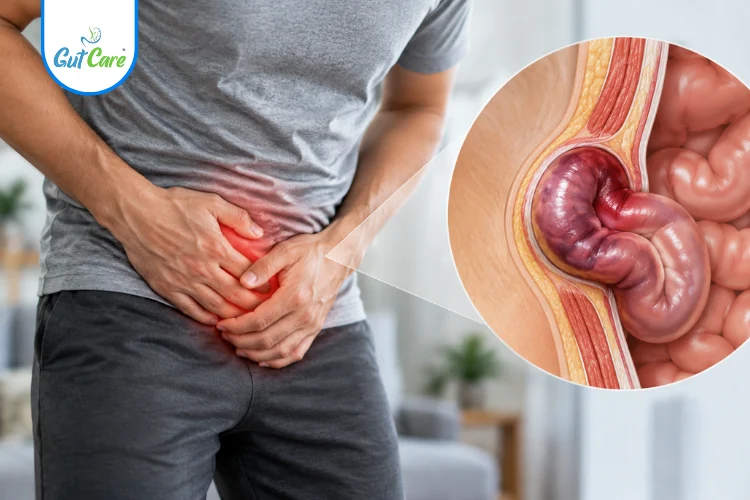
A hernia may begin as a small bulge or swelling, but in certain situations it can become a serious medical emergency. One of the most dangerous complications is a strangulated hernia, which occurs when the blood supply to trapped tissue is reduced or completely cut off.
Recognizing the warning signs early is important because delayed treatment can lead to tissue damage and other serious complications.
At Gutcare Clinics, patients with hernia symptoms are evaluated to determine the type of hernia, its severity, and whether urgent surgical treatment may be required.
This guide explains the signs of a strangulated hernia, why the condition is dangerous, how it differs from other hernias, and when emergency medical care is necessary.
Book an appointment Today!
What Is a Strangulated Hernia?
A hernia develops when an internal organ or tissue pushes through a weak area in the surrounding muscle or abdominal wall.
In some cases, part of the intestine or other tissue becomes trapped inside the hernia opening. If the blood vessels supplying that trapped tissue become compressed, blood flow may decrease.
This condition is known as a strangulated hernia.
Without adequate blood supply, the affected tissue can become damaged. This is why strangulated hernias generally require immediate medical assessment and often emergency surgery.
What Causes a Hernia to Become Strangulated?
A strangulated hernia can develop when tissue becomes tightly trapped within a narrow hernia opening.
Several types of hernias may potentially become strangulated, including:
- Inguinal hernia
- Femoral hernia
- Umbilical hernia
- Incisional hernia
- Ventral hernia
Strangulation does not happen in every hernia. However, any hernia that becomes suddenly painful, hard, tender, or impossible to push back should be medically evaluated urgently.
Signs of a Strangulated Hernia
Symptoms can develop suddenly and may become progressively worse.
1. Sudden Severe Hernia Pain
One of the most important strangulated hernia symptoms is sudden or rapidly increasing pain around the hernia.
A hernia that was previously painless or mildly uncomfortable may suddenly become extremely painful.
The pain may continue even while resting.
2. A Hernia Bulge That Becomes Hard or Tender
A hernia may normally feel soft and may reduce when lying down.
With strangulation, the swelling may become:
- Hard
- Firm
- Tender
- Painful when touched
The bulge may also become noticeably larger.
3. Hernia Cannot Be Pushed Back In
Some hernias are reducible, meaning the bulge can move back into the abdomen while lying down or with gentle pressure.
A strangulated hernia is usually irreducible, meaning the trapped tissue cannot return to its normal position.
Do not repeatedly or forcefully attempt to push a painful hernia back in. Seek urgent medical assessment instead.
4. Red, Purple, or Dark Skin Over the Hernia
Changes in skin colour around the swelling can be an important warning sign.
The skin may appear:
- Red
- Purple
- Darker than usual
- Inflamed
These changes may indicate compromised blood flow or tissue damage.
5. Nausea and Vomiting
A strangulated hernia involving the bowel may cause intestinal obstruction.
This can result in:
- Persistent nausea
- Repeated vomiting
- Loss of appetite
- Abdominal discomfort
Vomiting combined with a painful, firm hernia requires urgent medical attention.
6. Abdominal Bloating
If part of the intestine becomes trapped, food, gas, and digestive contents may no longer move normally through the bowel.
This can cause increasing abdominal swelling or bloating.
7. Difficulty Passing Stool or Gas
A strangulated hernia may obstruct the intestine.
Patients may experience:
- Constipation
- Inability to pass stool
- Inability to pass gas
- Increasing abdominal pressure
Complete inability to pass stool or gas together with severe abdominal pain or vomiting should be treated as an emergency.
8. Fever
A fever may develop if tissue damage or inflammation progresses.
Fever associated with severe hernia pain, vomiting, or skin colour changes requires immediate medical evaluation.
9. Rapid Heartbeat or Feeling Very Unwell
As complications progress, some people may develop a fast heartbeat, weakness, dizziness, sweating, or a general feeling of becoming seriously unwell.
These symptoms should never be ignored.
Strangulated Hernia vs Incarcerated Hernia
These two conditions are related but are not exactly the same.
An incarcerated hernia occurs when tissue becomes trapped and cannot be pushed back into the abdomen.
A strangulated hernia occurs when the trapped tissue loses an adequate blood supply.
An incarcerated hernia can sometimes progress to strangulation.
Because it is difficult to determine blood supply simply by looking at a hernia, an irreducible or suddenly painful hernia should be evaluated by a doctor promptly.
Why Is a Strangulated Hernia Dangerous?
The intestine and other abdominal tissues require a continuous blood supply to remain healthy.
When blood flow is blocked, tissue may begin to become damaged.
Without treatment, complications may include:
- Tissue death
- Intestinal obstruction
- Bowel perforation
- Infection inside the abdomen
- Sepsis
These complications can become life-threatening.
Early treatment significantly reduces the risk of severe tissue damage.
When Should You Go to the Emergency Department?
Seek immediate emergency medical care if a hernia is accompanied by:
- Sudden severe pain
- Rapidly worsening pain
- A hard or extremely tender swelling
- A hernia that will not go back in
- Red, purple, or dark skin over the bulge
- Persistent vomiting
- Severe abdominal bloating
- Inability to pass stool or gas
- Fever or significant weakness
Do not wait for the symptoms to disappear on their own.
If strangulation is suspected, prompt medical assessment is essential.
How Is a Strangulated Hernia Diagnosed?
A doctor will usually begin with a physical examination.
The examination may include checking:
- Location of the hernia
- Size of the swelling
- Tenderness
- Skin changes
- Whether the hernia can be reduced
- Signs of intestinal obstruction
Depending on the condition, investigations such as an ultrasound or CT scan may sometimes be used.
However, when clinical signs strongly suggest strangulation, treatment should not be unnecessarily delayed for testing.
Treatment for a Strangulated Hernia
A strangulated hernia generally requires urgent surgery.
The main goals of surgery are to:
- Release the trapped tissue.
- Restore blood circulation where possible.
- Assess whether the intestine or affected tissue remains healthy.
- Remove damaged tissue if necessary.
- Repair the weakness in the abdominal wall.
The exact surgical approach depends on factors such as the location of the hernia, the condition of the trapped tissue, and the patient’s overall health.
Can a Strangulated Hernia Be Treated Without Surgery?
A confirmed strangulated hernia usually cannot be safely managed using medicines, rest, belts, or lifestyle changes alone.
Medication may temporarily reduce discomfort, but it does not restore blood flow to trapped tissue.
Emergency surgical treatment is often necessary to prevent further complications.
Can Strangulation Be Prevented?
Not every case of strangulation can be prevented.
However, having a known hernia evaluated before complications develop may allow treatment to be planned rather than performed as an emergency.
Speak with a doctor if you notice:
- A new groin or abdominal bulge
- Increasing hernia size
- Recurrent discomfort
- Pain during lifting, coughing, or physical activity
- Difficulty reducing the hernia
- Increasing tenderness
Your doctor can determine whether monitoring or planned hernia surgery is appropriate.
Who Is at Higher Risk of Hernia Problems?
Factors associated with the development or worsening of abdominal wall hernias may include:
- Heavy lifting
- Chronic coughing
- Long-term constipation and straining
- Obesity
- Previous abdominal surgery
- Pregnancy
- Weakness of the abdominal wall
- Increasing age
Having one or more of these factors does not mean a person will develop a strangulated hernia, but persistent hernia symptoms should still be medically assessed.
Why Early Hernia Evaluation Matters
Many uncomplicated hernias are not immediate emergencies.
However, a hernia can sometimes become incarcerated or strangulated unexpectedly.
Early evaluation allows a surgeon to assess:
- Hernia size
- Location
- Symptoms
- Risk of complications
- Appropriate treatment options
- Whether planned surgery should be considered
At Gutcare Clinics, hernia assessment focuses on identifying the type and severity of the condition and recommending treatment based on individual clinical findings.
Conclusion
A strangulated hernia occurs when trapped tissue loses its blood supply.
Important warning signs include sudden severe hernia pain, a hard or tender bulge, inability to push the hernia back in, vomiting, abdominal swelling, inability to pass stool or gas, fever, and changes in skin colour around the swelling.
These symptoms should be treated as a medical emergency.
Prompt diagnosis and treatment can help prevent serious complications such as bowel damage, infection, and sepsis.
Find us here:Gutcare Clinics, Indiranagar, Bangalore | Dr. Yuvraj Singh Gehlot, Digestive Health Specialist
Frequently Asked Questions
1. What is the first sign of a strangulated hernia?
Sudden or rapidly worsening pain at the site of an existing hernia is an important warning sign. The swelling may also become firm, tender, or impossible to push back into the abdomen.
2. How quickly can a strangulated hernia become dangerous?
Tissue damage can begin once blood circulation becomes significantly reduced. There is no safe period to wait at home if strangulation is suspected. Urgent medical assessment is necessary.
3. Can a strangulated hernia go away on its own?
A suspected strangulated hernia should not be expected to resolve without medical treatment. Because blood supply may be compromised, emergency surgical treatment is often required.
4. What does a strangulated hernia look like?
The hernia may appear larger, tense, or swollen. The skin may sometimes become red, purple, or darker. However, appearance alone cannot confirm strangulation, so severe pain or an irreducible hernia should be assessed urgently.
5. What is the difference between an incarcerated and strangulated hernia?
An incarcerated hernia contains trapped tissue that cannot be pushed back into the abdomen. A strangulated hernia occurs when the trapped tissue also loses its blood supply. An incarcerated hernia can potentially progress to strangulation.