
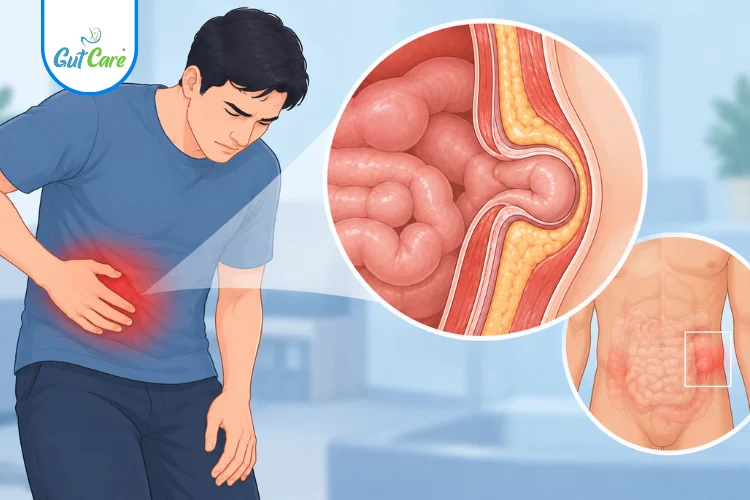
A Spigelian hernia is a type of abdominal wall hernia that develops through a weak area in the side of the abdominal wall, near the semilunar line. Unlike a typical groin hernia, it occurs along the side of the abdominal muscles and can be difficult to see from the outside.
Some people notice a small lump or localised discomfort. Others mainly experience abdominal pain that becomes more noticeable when coughing, bending, lifting, or straining. Because the symptoms can be vague, a Spigelian hernia may be confused with other causes of abdominal pain.
At Gutcare Clinics, Bangalore, a clinical assessment can help determine whether persistent abdominal wall pain or a suspected lump needs further investigation.
If you have recurring abdominal pain or a new abdominal lump, consider arranging an evaluation with a qualified surgeon instead of trying to identify the cause yourself.
Book Your Consultation Today
What Causes a Spigelian Hernia?
A Spigelian hernia develops when tissue pushes through a weak point in the Spigelian fascia, a layer of connective tissue in the abdominal wall. The weakness may develop gradually or become more noticeable when pressure inside the abdomen increases.
Possible contributing factors include:
- Age-related weakening of abdominal tissues
- Being overweight or having obesity
- Pregnancy
- Repeated coughing
- Long-term constipation and straining
- Repeated heavy lifting or activities that increase abdominal pressure
- An underlying weakness in the abdominal wall
Having one of these factors does not mean a person will develop a hernia. Sometimes there is no obvious single cause.
Spigelian Hernia Symptoms
Symptoms vary depending on the size and location of the hernia and whether tissue has become trapped.
Common symptoms
Possible signs include:
- A lump or swelling on the side of the abdomen
- Localised abdominal pain or tenderness
- Pain that increases with coughing, lifting, bending, or straining
- Pressure or discomfort in one area of the abdominal wall
- A bulge that appears during activity and becomes less noticeable when resting
A visible lump is not always present. Because a Spigelian hernia can sit beneath layers of abdominal muscle, it may be difficult to detect during a routine examination.
If abdominal pain keeps returning or is associated with a localised swelling, medical assessment can help distinguish a hernia from a muscle problem or another abdominal condition.
When Can a Spigelian Hernia Become Dangerous?
A Spigelian hernia can become incarcerated, meaning tissue protruding through the abdominal wall becomes trapped and cannot move back easily.
If the blood supply to trapped tissue is reduced, strangulation can occur. This is a medical emergency.
Warning signs that need urgent assessment
Seek urgent medical care if you develop:
- Sudden or severe abdominal pain
- A lump that becomes very painful, firm, or cannot be pushed back
- Increasing swelling
- Nausea or vomiting
- Abdominal bloating with difficulty passing stool or gas
- Fever or feeling increasingly unwell
These symptoms can have other causes, but they should not be ignored.
How Is a Spigelian Hernia Diagnosed?
Diagnosis usually begins with a medical history and physical examination. The clinician may ask whether the pain or swelling changes with standing, coughing, lifting, or lying down.
A physical examination may not identify every Spigelian hernia, especially when the defect is small or lies beneath the abdominal muscle.
Imaging tests
Ultrasound: An abdominal wall ultrasound may identify a hernia and can sometimes assess the area while you move or strain.
CT scan: CT can provide a detailed view of the abdominal wall and may be useful when the diagnosis is uncertain or complications need to be assessed.
The choice of imaging depends on the symptoms and examination findings.
How Is a Spigelian Hernia Treated?
A confirmed Spigelian hernia does not usually close by itself. Surgical repair is commonly considered, particularly when symptoms are present or there is concern about the hernia becoming trapped.
Surgical repair options
The goal is to return the protruding tissue to the abdominal cavity and repair the weakness in the abdominal wall. Depending on the individual case, surgery may be:
- Open repair: An incision is made over the hernia.
- Laparoscopic repair: Small incisions are used with a camera and specialised instruments.
- Robotic-assisted repair: A minimally invasive approach that may be suitable for selected patients.
A surgical mesh may be used to reinforce the abdominal wall, depending on the defect and the chosen repair technique.
The best approach is not identical for everyone. Hernia size and location, previous abdominal operations, overall health, and the surgeon’s assessment all matter.
What Is Recovery Like After Spigelian Hernia Surgery?
Recovery depends on the repair method and the individual’s health. Your surgical team may give specific advice about wound care, pain control, walking, returning to work, lifting, exercise, and follow-up.
Avoid comparing your recovery with someone else’s. Your surgeon can advise when it is appropriate to resume strenuous activity.
Can a Spigelian Hernia Be Prevented?
There is no guaranteed way to prevent every Spigelian hernia because some people have an underlying weakness in the abdominal wall.
Managing factors that repeatedly increase abdominal pressure may help reduce strain. For example, persistent constipation or chronic coughing should be discussed with a healthcare professional, and safe lifting techniques can reduce unnecessary strain.
These measures cannot repair an existing hernia. A persistent lump or abdominal wall pain should be medically assessed.
Spigelian Hernia vs Other Hernias
The location helps distinguish a Spigelian hernia from other common types:
- Spigelian hernia: Develops through the abdominal wall near the semilunar line.
- Inguinal hernia: Develops in the groin.
- Umbilical hernia: Occurs around the belly button.
- Incisional hernia: Develops through a previous abdominal surgical incision.
Location alone is not enough to confirm the type of hernia. Examination and, when needed, imaging provide a more reliable diagnosis.
When Should You See a Doctor?
Consider medical assessment if you have a recurring lump on the side of your abdomen, persistent localised abdominal wall pain, discomfort that worsens with coughing or lifting, or a suspected hernia that has not been formally diagnosed.
For sudden severe pain, vomiting, a painful firm lump, abdominal swelling, or difficulty passing stool or gas, seek urgent medical care.
Conclusion
A Spigelian hernia is an uncommon abdominal wall hernia that can be overlooked because the swelling may be small or hidden beneath muscle layers. Symptoms can include localised pain, tenderness, pressure, or a lump that becomes more noticeable with activity.
Diagnosis may involve a physical examination and imaging such as ultrasound or CT. When a Spigelian hernia is confirmed, surgical repair is commonly considered because it does not usually disappear on its own and trapped tissue can cause complications.
If you have persistent abdominal wall pain or a new lump, proper medical assessment can help identify the cause and guide the next step.
Looking for evaluation of a suspected Spigelian hernia in Bangalore?Find us here:Gutcare Clinics, Indiranagar, Bangalore | Dr. Yuvraj Singh Gehlot, Digestive Health Specialist
Frequently Asked Questions About Spigelian Hernia
What is a Spigelian hernia?
A Spigelian hernia is a type of abdominal wall hernia that develops through a weak area near the semilunar line, usually along the side of the rectus abdominal muscle.
What are the symptoms of a Spigelian hernia?
Symptoms may include a localised abdominal lump, pain, tenderness, pressure, or discomfort that becomes more noticeable with coughing, lifting, bending, or straining. A visible lump may not always occur.
Can a Spigelian hernia go away on its own?
A confirmed Spigelian hernia does not usually close on its own. A surgeon can assess the hernia and discuss whether repair is appropriate based on its symptoms and characteristics.
Is a Spigelian hernia dangerous?
It can become serious if tissue becomes trapped inside the hernia. Incarceration and strangulation can occur, so sudden severe pain, vomiting, or a painful firm lump needs urgent medical assessment.
How is a Spigelian hernia diagnosed?
A clinician may diagnose it through a physical examination, but ultrasound or CT may be needed when the hernia is small, hidden beneath muscle, or difficult to confirm clinically.
What is the treatment for a Spigelian hernia?
Surgical repair is commonly considered for a confirmed Spigelian hernia. Depending on the case, repair may be open, laparoscopic, or robotic-assisted, and mesh may be used to reinforce the abdominal wall.
How long does it take to recover from Spigelian hernia surgery?
Recovery varies according to the surgical technique, hernia characteristics, and the patient’s overall health. The surgical team will provide individual advice about work, exercise, lifting, and follow-up.